

Chelsea boss Liam Rosenior takes charge of his first Premier League game this weekend as the Blues take on Brentford at Stamford Bridge.
After a run of five games without a win, Chelsea parted ways with Enzo Maresca at the start of the year.
Since then, Chelsea have hired Liam Rosenior to succeed the Italian, after a successful stint at Chelsea’s affiliate club, Strasbourg.
The 41-year-old may be young, but his results at Strasbourg certainly caught the eye, as he led the Ligue 1 underdogs to a seventh-place finish last term.
Chelsea clearly think the Englishman has shown enough potential to take the club to the next level – but how will the Blues look under Rosenior?
Who is Liam Rosenior?
Rosenior entered management after a modest playing career, which included appearances in the Premier League for Fulham, Hull City, and Brighton & Hove Albion.
His first managerial role came as interim boss of Derby County before moving on to Hull City in 2022.
The Englishman guided the Tigers to a respectable seventh-placed finish in the 2023/24 Championship season, missing out on the play-offs by just three points.
He eventually moved on to Strasbourg in 2024/25, who he left sitting seventh in Ligue 1 and top of the Conference League table.
How did his Strasbourg side line up?
During his successful spell in France, Rosenior’s side often lined up in a 5-2-3, but he was ultimately flexible in his approach, as long as his side ended up as a 3-2-2-3 in possession.
In this system, his wing-backs would push high and take turns with the wingers to hold the width and invert into the centre.
By doing this, he created a box midfield with 3 defenders to receive passes from and 3 advanced players to find in attack.


What is Rosenior’s tactical philosophy?
In 2018, Rosenior told the Guardian that if he ever got the opportunity to coach, he would look to combine the “beautiful with the practical”.
His Strasbourg side liked to keep the ball, but not for possession’s sake. As the stat below shows, they like to keep hold of the ball in their own defensive third, which is where they see most of the ball.
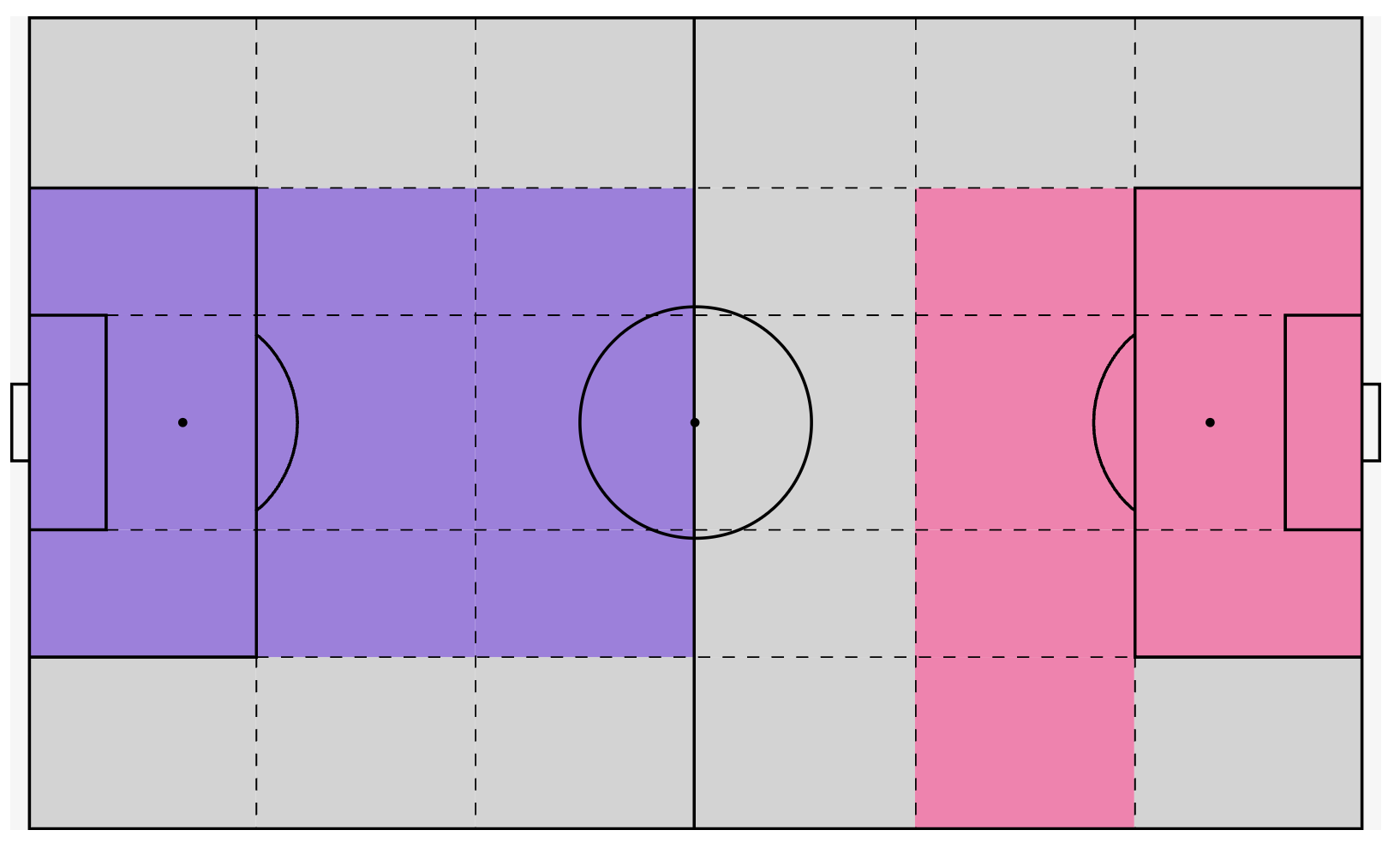
Strasbourg Opta Analysis – Zones of Control showing Strasbourg’s (purple zones, left side of the pitch) has more than 55% of total touches in those areas. The opposing team (pink zones, right side of the pitch) has more than 55% of total touches in their respective areas. Areas not coloured purple or pink are considered contested, meaning neither team has more than 55% dominance. (Source: Opta Analyst)
Influenced by Roberto De Zerbi, this is done to bait the opposition into pressing his side so they can hit them with quick passes into the box midfield and get his side into the final third.
But should the opposition side not take the bait, Rosenior is quite happy for his team to shift the ball from side to side, looking for the opportune moment to play a through ball into the attacking players.
Strasbourg’s eccentric build-up
Rosenior’s Strasbourg side could be very adventurous when building out from the back.
Most interestingly, he would often use his keeper high in possession to create a back five.
In a high-risk, high-reward tactic, when teams pressed high, this allowed them an extra player to help escape pressure, and a spare man at the other end of the pitch to cause trouble when the ball arrived.
This also meant his defenders had to be competent in playing out, maintaining their cool when put under pressure, and not panicking into hoofing it long.
It’s a tactic that obviously led to great success but does come with many risks.
It will come as no surprise that Strasbourg rank highest for errors leading to shots (15) this season.
And this risky approach has certainly led to some comical moments that could have been much worse, as seen below in this clip during the Crystal Palace game earlier this season.
Crystal Palace can’t believe it
Just like the first half, Palace miss an open goal…This time Adam Wharton hits the crossbar
@tntsports & @discoveryplusUK pic.twitter.com/TC194dHPZD
— Football on TNT Sports (@footballontnt) November 27, 2025
If this approach sounds similar to Maresca, well, that’s because it is.
The Italian also tinkered with a 3-2-2-3 formation in possession, sometimes switching to a diamond in order to get Enzo Fernandez higher up.
Moreover, Maresca had similar principles to Rosenior in terms of baiting the opposition with lots of short, slow passes before launching quick attacks. Indeed, Chelsea rank second highest (30) for fast breaks in the Premier League this season.
If you were unsure why Rosenior was chosen as Maresca’s successor, just look at the graphics below, which show the striking similarities between the two sides in balancing short passes with direct attacks.
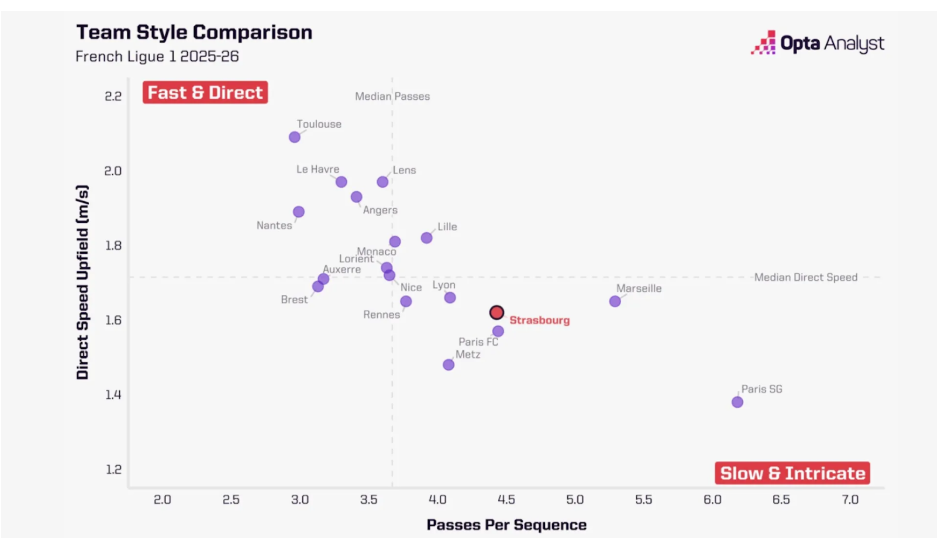
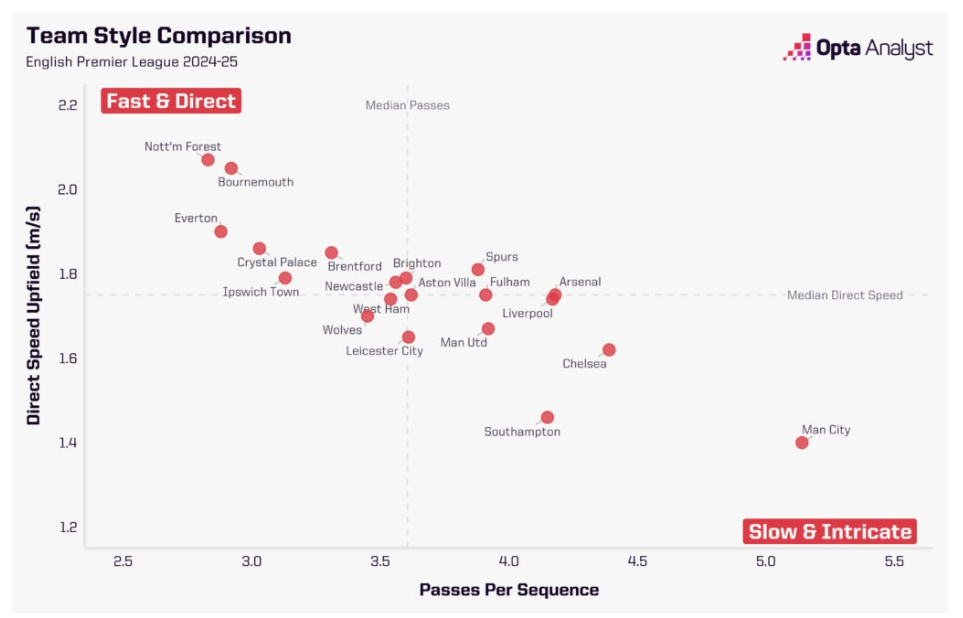 Of course, these similarities are no surprise. Owned by the BlueCo group, who run Chelsea, Strasbourg are effectively the Blues’ B side, and Todd Boehly is clearly looking to instil a consistent philosophy throughout his clubs.
However, there are still question marks over how Rosenior will apply this philosophy to his new club, Chelsea and the Premier League.
How risky is building out from the back with Robert Sanchez?
As mentioned before, Rosenior likes his keepers to effectively play as outfielders during build-up. This came with great success during his first season, as keeper Dorde Petrovic excelled in drawing players towards him before picking out the forwards with line-breaking passes.
However, with Robert Sanchez between the sticks at Stamford Bridge, Rosenior hardly has an Ederson or Manuel Neuer at his disposal.
It will be interesting to see if Rosenior adapts his approach to accommodate Sanchez or dips into the transfer market for better options – akin to what Pep Guardiola did when replacing Joe Hart with Claudio Bravo during his first season at City.
It will also be interesting to see how Chelsea’s defenders fare under Rosenior. Under Maresca, the Blues ranked second highest for errors leading to shots and goals (61) as errors from an inexperienced side became the Achilles heel of the Italian’s reign.
Will Rosenior rein it in a bit, or will he continue with this high-risk approach, hoping he will be given enough time for his young Chelsea side to mature?
Can Liam Rosenior defeat the low block?
Another question mark for Rosenior is whether he can beat the low-blocks of more organised Premier League defences.
The Englishman’s approach is all rosy if teams fall for the trap, but when teams don’t press and sit off Chelsea, it will be interesting to see how his side scores.
The Premier League is awash with more compact and rigid defences. One fears the patience will start to wear thin against low-block sides – just ask under-pressure Arne Slot at Liverpool?
Indeed, his Strasbourg side wasn’t a great attacking side. They ranked just eighth for xG this season, but fourth for xGA.
It’s an approach that sees a compact center keep the opposition quiet, but does it have enough offensively to become an elite Premier League side?
Interestingly, when Rosenior was dismissed by Hull, the owner suggested it was the lack of attacking football that cost him the job.
The hope is that with better attacking players at his disposal, Rosenior can improve his tepid attacking record.
Who will invert for Chelsea?
We know Rosenior likes to invert full-backs – but the question at Chelsea is who will do the inverting?
Under Maresca, Mark Cucurella and Malo Gusto would often take turns inverting. Other times, captain Reece James would invert alongside Moises Caicedo, allowing Enzo Fernandes to push on.
But as Maresca learnt, having full-backs in threatening central areas isn’t that great for your attack.
One option is asking Estevao to play inside, which the Chelsea hierarchy sees as the long-term plan for the youngster. Although that does means less space and more bodies to dribble through. This means the skilful Brazilian may be better placed out wide, where he will have more opportunities for one vs ones.
Another solution is bringing in Andrey Santos to play alongside Caicedo in midfield. The 21-year-old is familiar with Rosenior, having spent last season on loan in Strasbourg, and may suit a more defensive role better than Enzo.
With Santos playing, this would not only allow Enzo to flourish further forward, but it would also allow Reece James to bomb forward as he did under Thomas Tuchel during his successful spell at the club – assuming he can stay fit.
Will Rosenior be a success?
Rosenior looks like the natural successor to Maresca. With a very similar playing philosophy, the Chelsea players should be able to adapt quickly to the Englishman’s ideas.
However, with limited experience at the top level, there will be question marks over whether Rosenior is the right man to take Chelsea from a side with lots of potential to a side challenging for the biggest prizes.
Rosenior exceeded expectations with a weaker side at Strasbourg. On paper, with better players, he should exceed even further at Chelsea.
Unfortunately for Rosenior, football isn’t played on paper. But it will certainly be exciting to find out how an English manager does at a big six club.
How Chelsea might line up under Liam Rosenior



 Savinho to Spurs: City Must Now Decide on £60m Sale
- Meslier Joins Arsenal on a Free as Kepa Prepares to Exit
- Forest Demand Guaranteed British Record as City’s £120m Anderson Bid Looms
- Rashford Wants Barca or Bayern — Spurs Are Just the Fallback Option
- Tottenham Agree £52m Fixed Fee for Brighton’s Van Hecke
- Tottenham Threaten to Hijack Summerville as United’s Window Unravels
- Liverpool and United Circle Juventus’s Thuram at €50m
- Arsenal agree personal terms with Manu Koné in €45m Roma deal
- Man United Target Summerville and Fernandes in £130m West Ham Double Deal
- Nico Paz Set to Stay at Como as Real Madrid Step Back