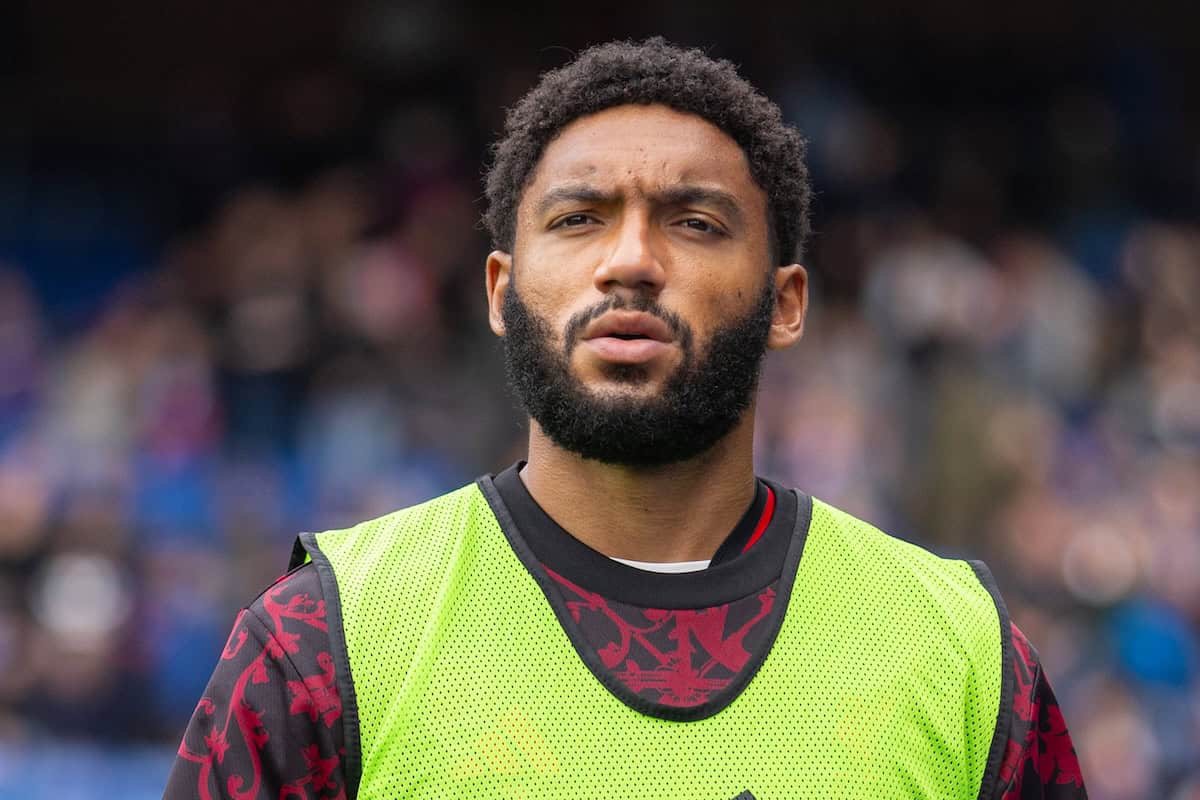
Joe Gomez cut a forlorn figure as he warmed up on the touchline at Liverpool this weekend. As he gazed towards the Kop, where a back four containing two midfielders laboured in vain to prevent Arne Slot’s side from conceding three goals for a second straight league game, there was an air of resignation about the 28-year-old England international.
Gomez is the club’s longest-serving player, a model professional who has won every club honour in the book over the course of a decade at Anfield. Over the course of 248 appearances, the versatile centre-back’s commitment to Liverpool has been beyond question.
“I know how blessed I am to be here,” Gomez said last December. “It is the best club in the world in my eyes.”
How Joe Gomez has struggled for minutes under Arne Slot
Even so, there will inevitably come a point when even a player of Gomez’s unwavering loyalty grows tired of waiting for a call that never comes. Despite an impressive late cameo in the 1-0 victory over Arsenal at the end of August, he has barely featured this term. Gomez has accumulated just 43 minutes of playing time in the league, with his only starts coming against Southampton and Crystal Palace in the League Cup. Since Slot took up the managerial reins from Jürgen Klopp last summer, he has been gradually consigned to the role of bit-part player.
A susceptibility to Injury, the perennial bane of his Liverpool career, has not helped. A case in point came last December, when fellow defender Ibrahima Konaté was sidelined by a knee injury. In the Frenchman’s absence, Gomez enjoyed a run of six straight starts, delivering a series of commanding performances, only to suffer a hamstring injury that would keep him out of the next 17 games. He did not return to the match-day squad until May, by which time the title was won, and did not play another minute.
Why Joe Gomez didn’t play for Liverpool against Nottingham Forest
For all his injury travails, however, the case for Gomez’s addition to a defence that has now conceded 20 goals in a dozen games is increasingly compelling, particularly with Konaté in the most wretched form of his Anfield career. Despite the absence through injury of Conor Bradley and Jeremie Frimpong, Gomez did not start Liverpool’s 3-0 defeat to Forest on Saturday because, as Slot explained afterwards, he was nursing an injury and had not trained all week.
Perhaps that explains why Gomez wore such a grim expression – one that reflected the sombre faces in the stands – as he limbered up on the sidelines. Maybe that is why he went about his warm-up routine with uncharacteristic half-heartedness. But perhaps Gomez also looked downbeat because Slot has shown such a marked reluctance to play him, even when fit.
That Gomez has not featured more prominently under the Dutchman is perhaps down partly to his playing style. While Slot’s tactical approach, steeped in the principles of Total Football, requires the centre-backs in his 4-3-3 system to be adept at progressing the ball forward, Gomez’s game lends itself more readily to disrupting opposition attacks than initiating them. That is not to deny the defender’s ability on the ball, a quality that has improved under the Dutchman’s tutelage, but rather to acknowledge that his strengths lie elsewhere.
Not for the first time this season, Slot’s emphasis on playing out from the back seemed to shape his decision-making as Liverpool sought a route back into the game. That meant Ryan Gravenberch dropping back into central defence following the 55th-minute withdrawal of Konaté. Alongside him was Curtis Jones, who had shared right-back responsibilities with Dominik Szoboszlai up to that point. The evidence of this season suggests Slot might have made these changes even if Gomez had been deemed fit (and if he wasn’t, it seems legitimate to wonder why he was even on the bench in the first place).
How Arne Slot’s brand of Total Football has affected Joe Gomez
The problem for the Dutchman is that putting square pegs into round holes has tended to work against his side this season. When Slot reinvented Gravenberch as a defensive midfielder last season, it was rightly hailed as an inspired move. Gravenberch’s robust physicality, positional awareness and ability to find a line-breaking pass made him a natural fit for the No 6 role. But not every player can be reinvented in such a way.
An innate gambler, Slot has tended to throw on attacking players in numbers on the frequent occasions his team have found themselves chasing a game this season. The most glaring example came at home to Manchester United last month, when Liverpool played the latter stages with Florian Wirtz, Cody Gakpo, Mohamed Salah, Hugo Ekitike and Federico Chiesa on the pitch. That top-heavy hotchpotch forced an equaliser, only to concede a second goal late on as United exploited the lack of defensively-minded players in the Anfield ranks.
Virgil van Dijk ended that game as an emergency striker, just as he did in the following weekend’s defeat at Brentford. Of course, when such decisions come off, the manager looks like a genius. Too often this term, they haven’t. As former Liverpool midfielder Dietmar Hamann recently remarked in an exclusive interview on this site, “the balance needs working on”.
Sometimes, the simplest solutions are the most effective – and deploying players in their natural positions is about as straightforward as it gets.
Either way, the logic of omitting Gomez looks increasingly flawed. In the final season of Klopp’s reign, Gomez offered a reminder of his adaptability, variously playing at centre-back, right-back, left-back and defensive midfield across the course of 51 appearances. Under Slot, who puts a premium on positional versatility, he can’t buy a place in the starting lineup – even with the champions leaking goals like a broken faucet. Like so much of Liverpool’s season, it makes no sense.

 Savinho to Spurs: City Must Now Decide on £60m Sale
- Meslier Joins Arsenal on a Free as Kepa Prepares to Exit
- Forest Demand Guaranteed British Record as City’s £120m Anderson Bid Looms
- Rashford Wants Barca or Bayern — Spurs Are Just the Fallback Option
- Tottenham Agree £52m Fixed Fee for Brighton’s Van Hecke
- Tottenham Threaten to Hijack Summerville as United’s Window Unravels
- Liverpool and United Circle Juventus’s Thuram at €50m
- Arsenal agree personal terms with Manu Koné in €45m Roma deal
- Man United Target Summerville and Fernandes in £130m West Ham Double Deal
- Nico Paz Set to Stay at Como as Real Madrid Step Back