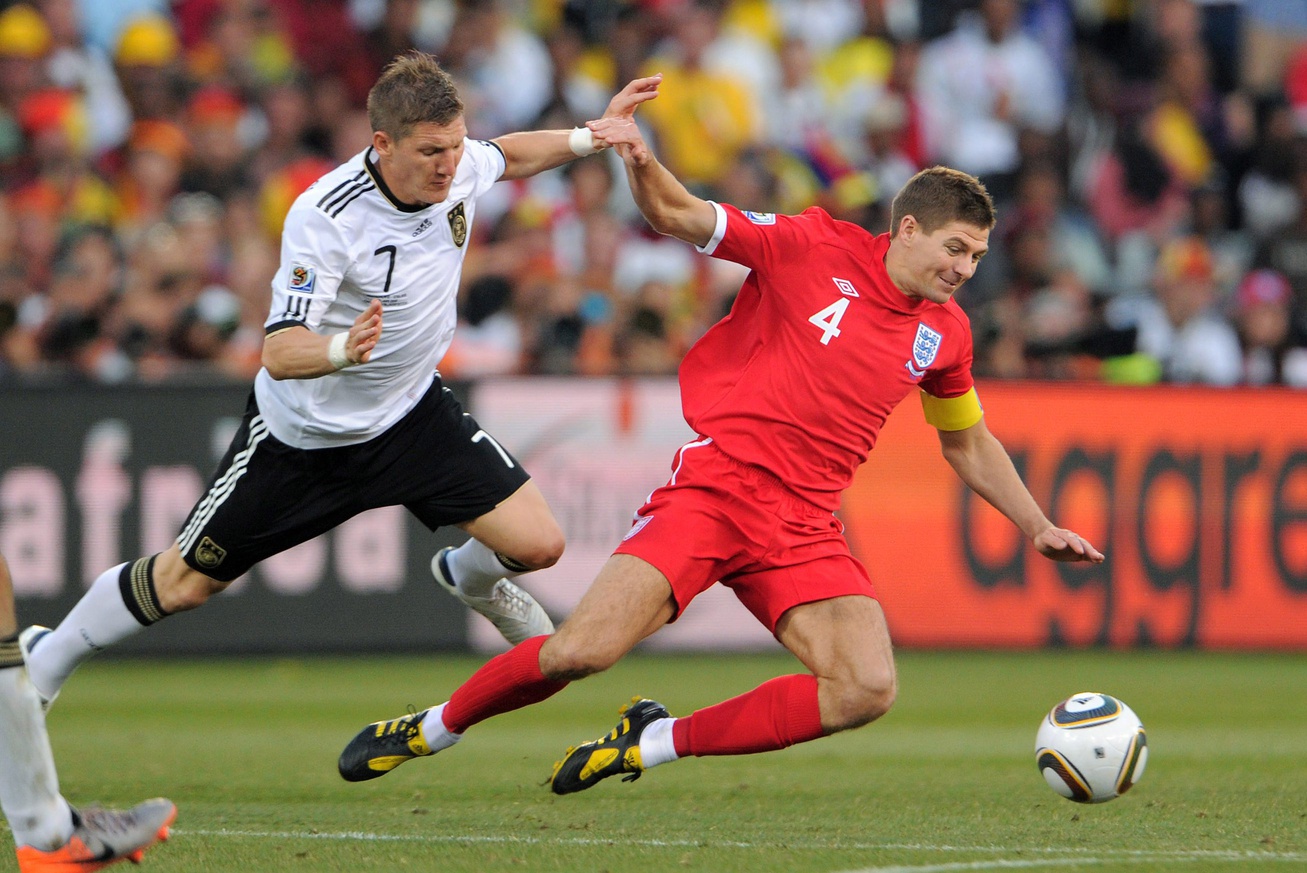
Steven Gerrard’s first senior goal for Liverpool, scored against Sheffield Wednesday at Anfield in December 1999, was a belter.
Lurking just outside the centre circle, the 19-year-old received a square pass from full-back Rigobert Song before surging past nearby opposition midfielder Danny Sonner. With space opening up before him, Gerrard quickly reached the edge of the area, where he slalomed past Des Walker and Emerson Thome before drilling a low finish across the goalkeeper, Kevin Pressman.
It was a virtuoso effort, one that set the tone for a career that would be littered with brilliant goals, yet it was nothing new for Gerrard. He had honed such moves on the streets of Huyton, the Merseyside town where he grew up, and later at the Vernon Sangster Sports Centre and Melwood, where he took his first steps as a Liverpool player.
“This was the type of stuff I would do as a kid when I was coming through the ranks, back when I found everything a little bit easier,” Gerrard would later recall. “Now I was doing it at Anfield, in front of the Sky Sports cameras.
“When things like that happen, you realise you can do it at that level and those are the moments that help you grow as a player.”
‘Could I be the Steven Gerrard that played in our generation? I’m not sure’
Yet that goal, and so many others that followed, might never have happened today. In an era when football is about tactical discipline and carefully rehearsed patterns, Gerrard’s run would have been halted by a deep-lying midfielder long before he reached Wednesday’s defence; that is, if he was even allowed the freedom to make such a run in the first place.
The modern emphasis on holding position, doing a job, not venturing beyond the remit prescribed by the manager, makes Gerrard believe he would have struggled to prosper in the modern game. So too does the lower threshold for bookings, which has consigned the combative physical duels he once contested against the likes of England contemporaries Paul Scholes and Frank Lampard firmly to the past. In the age of the micromanaged midfielder, Gerrard’s extraordinary skill set might never have been given proper expression.
Liverpool legend Steven Gerrard: ‘It’s a more technical game’
“I’m not sure I could be respected as well as I got respected during my career now, in today’s game,” Gerrard told the Rio Ferdinand Presents podcast. “I think it’s changed, it’s a more technical game, it’s a more academy-based game, tactical.
“Academies are more technical now, the rules of the game have moved, they’ve evolved. I look at my battles against some of the [past midfield] players, [Lampard] in the Champions League, Paul Scholes, where you could try and leave a stamp on him and they would try and leave a stamp on me. It would be a 90-minute battle over the course of the game, and it could set a tone.
“You get booked for nothing now, you can go off a football pitch for nothing, and that’s what would concern me now. Could I be the Steven Gerrard that played in our generation? I’m not sure. I’d have to adapt, and I think that would take a lot away from my style.”
Steven Gerrard’s disciplinary record at Liverpool
Gerrard was not known for playing with the handbrake on, either tactically or physically. That first Liverpool goal against Sheffield Wednesday, tinged with the wanderlust that would come to define his early years, was preceded by a first dismissal, the midfielder receiving a straight red for a reckless tackle on Kevin Campbell at the conclusion of an overwrought Merseyside derby two months earlier.
Gerrard, who saw red seven times over the course of his Anfield career and once for England, was not the only great English midfielder of his era to fall foul of officialdom, even if he was the most prominent offender. Scholes, whose tackling ability was far and away the weakest element of his game, saw red four times for Manchester United, while Chelsea’s Lampard was given his marching orders on three occasions.
The inability of that trio to combine effectively at international level, which Gerrard puts down to a combination of ego and a difficult dressing room culture at the time, was a source of sleepless nights for several England managers. Of the three, however, it is Scholes whom Gerrard believes would have proved the most effective operator today.
Why Gerrard believes Paul Scholes would be the best midfielder in today’s Premier League
“I think Scholes, now, would be the best midfielder in the Premier League,” said Gerrard, who has been linked with a return to Rangers following the dismissal of Russell Martin.
“Because Scholesie, for me, was very much an in-possession controller of a midfield, controller of a game. You get close and he could pop it around you, he could play with the outside of his foot, switch the play, score important goals, make the last pass.
“Scholesie’s [vulnerability], for me, was can you get him doing the other side of the game, can you take him the other way, can you be physical with him? He’d get booked against you. [With] these type of things, you could maybe try and get the better of him.
“But I’m not sure in today’s game you could leave one on Scholesie, for example, so he would have everyone terrorised in the Premier League now, he would be the best midfielder in the Premier League now, hands down. I probably wouldn’t.”
Could Liverpool legend Gerrard have adjusted to modern demands?
Could Gerrard have adapted? Almost certainly. The evolution of his game at Anfield, where he was given his head by Gérard Houllier before evolving into a more tactically disciplined player under Rafael Benítez – in his twilight years, Brendan Rodgers would reinvent him as a deep-lying midfielder – all but confirms as much.
Yet Gerrard was never about conformism; it was his spontaneity, his gift for moments of individual brilliance, for bending a match to his will, that made him the player he was. Today, the buccaneering runs and long-range strikes against the likes of Olympiacos and West Ham, goals that defined Champions League and FA Cup triumphs, might never have happened. And the game would be the poorer for it.

 Argentina Face FIFA Investigation After World Cup Final Confrontations
- Guimarães Bid Incoming and Williams Opens Door in Arsenal’s £167m Push
- Ferran Torres Transfer: Liverpool and PSG Compete for Barcelona Forward
- Napoli Push to Swap Vicario for Milinkovic-Savic in No-Fee Summer Deal
- Savinho to Spurs: City Must Now Decide on £60m Sale
- Meslier Joins Arsenal on a Free as Kepa Prepares to Exit
- Forest Demand Guaranteed British Record as City’s £120m Anderson Bid Looms
- Rashford Wants Barca or Bayern — Spurs Are Just the Fallback Option
- Tottenham Agree £52m Fixed Fee for Brighton’s Van Hecke
- Tottenham Threaten to Hijack Summerville as United’s Window Unravels