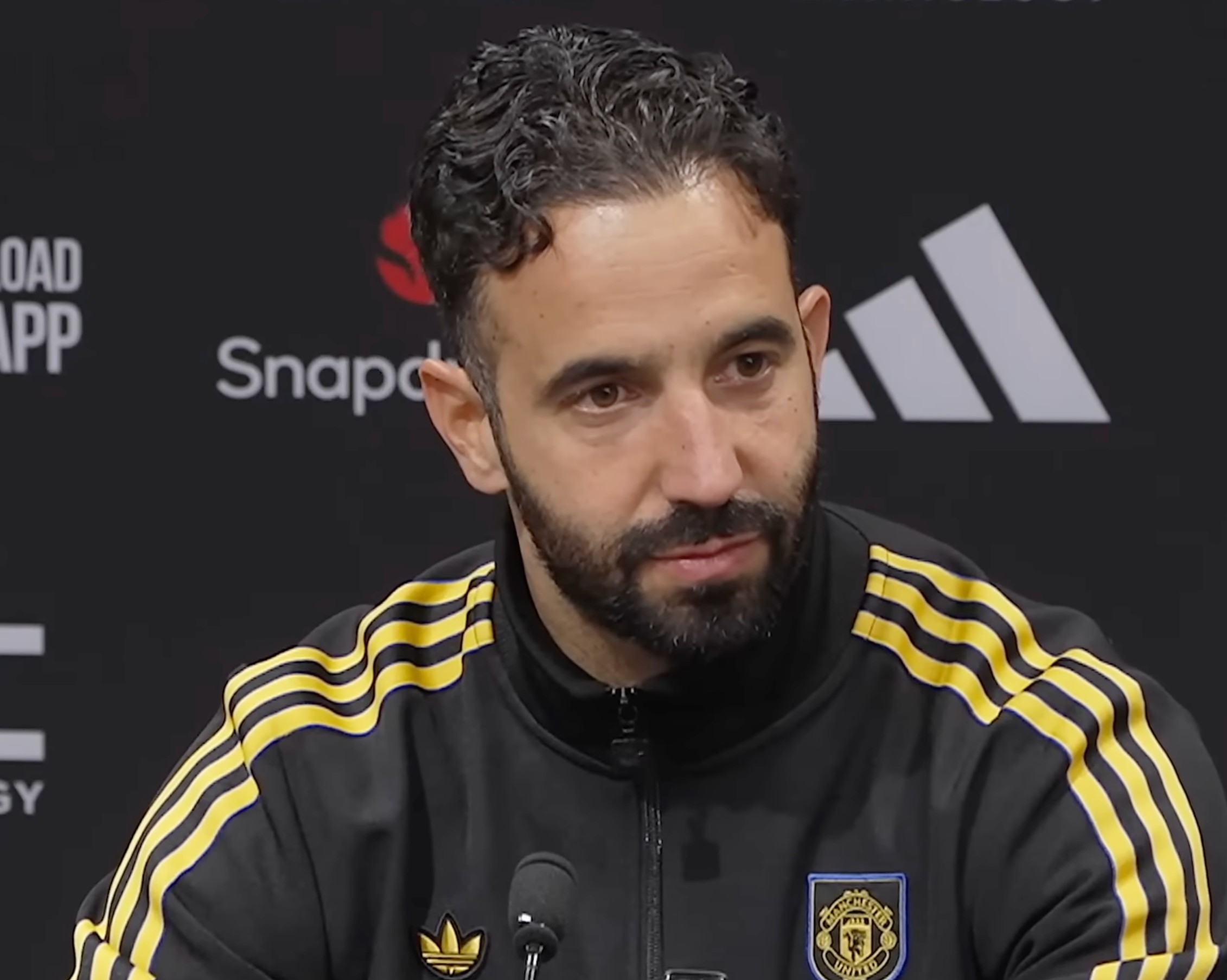
Ruben Amorim finished 15th in his first season as Manchester United manager, having taken the job midway through the 2024/25 campaign.
That was United’s lowest finish in the history of the Premier League — a competition they dominated for much of the 1990s and 2000s.
United have started the 2025/26 season much better. They sit eighth going into Monday’s home clash with Bournemouth, while a win in that game would see them rise to fifth.
Nevertheless, Amorim told reporters ahead of Monday’s match that he and his team are “underachieving”.
Ruben Amorim admits Manchester United are “underachieving”
Amorim’s comments came in response to legendary former United midfielder Paul Scholes claiming on a podcast that the Portuguese coach was “not the right man” for the manager’s job at Old Trafford.
When asked about the criticism from Scholes, Amorim told reporters: “I think it’s normal.
“It’s a fact that me, as a manager of Manchester United, I think we are underachieving. We should have more points, especially this season. So I take that naturally.
“Sometimes they don’t have all the information and see Manchester United with the standards they lived here, always winning. It’s hard for them to see their club in this situation.”
Man United’s slump since Sir Alex Ferguson left
Scholes won 11 Premier League titles in 19 seasons as a Man United player. All of those triumphs came under iconic former boss Sir Alex Ferguson, who oversaw 13 Premier League title wins in total, as well as five FA Cups, four League Cups, two Champions Leagues and one European Cup Winners’ Cup.
Ferguson’s last Premier League title came in his final season in charge in 2012/13. United have not been champions of England since, with Manchester City replacing them as the dominant force with seven titles in the last 12 seasons. Chelsea and Liverpool have also won the Premier League multiple times since United’s last success.
Amorim is United’s sixth permanent manager since Ferguson left. None of the five before him were able to deliver Premier League glory. Indeed, only two managed to lead United to second place — Jose Mourinho in 2017/18 and Ole Gunnar Solskjaer in 2020/21. United finished at least 12 points behind champions City in both of those seasons.
Despite United’s relative struggles in recent years, they are still comfortably ahead of all of their rivals at the top of the all-time Premier League table.
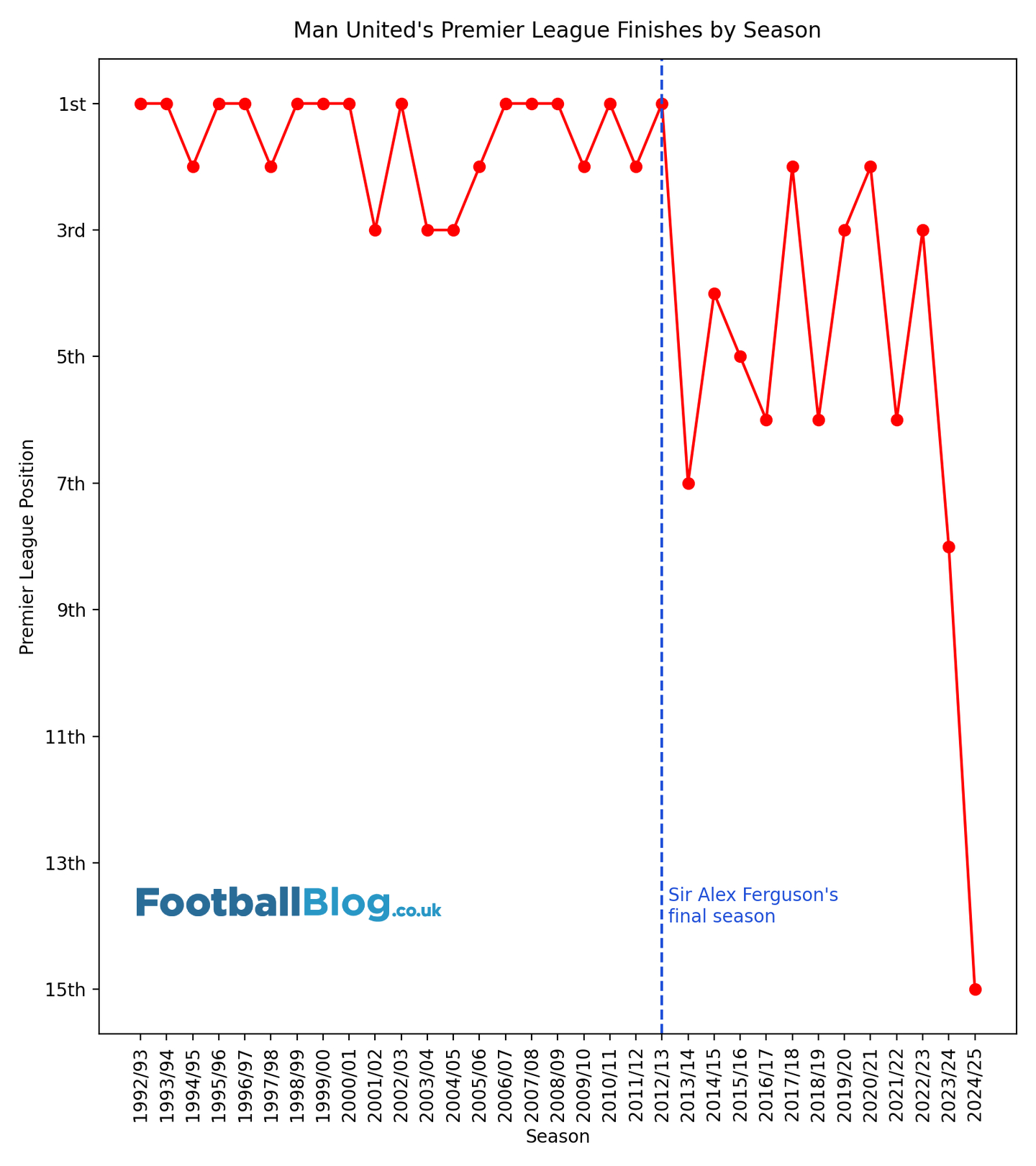
A graph displaying Man United’s Premier League finishes by season
While Amorim accepts that United are currently “underachieving”, it is perhaps unfair to compare him — or any modern United manager — against what Ferguson achieved. Ferguson unquestionably overachieved during his remarkable quarter of a century at Old Trafford.
However, the top of the Premier League has also become far more competitive, while United’s once-overwhelming financial dominance has been significantly diluted.
Where should Man United be in the Premier League table?
“This is Manchester United we are talking about.” These words are frequently used by former United captain Gary Neville in his on-air rants about the latest developments at Old Trafford. Neville played alongside Scholes for many years. Their teammates included Roy Keane and Wayne Rooney, both of whom now also occupy prominent media roles.
When these former Ferguson disciples talk about United, it is almost impossible for them not to compare the club’s current position to how it was in their era. That comparison, however, is not entirely fair on Amorim.
For much of Ferguson’s reign during the Premier League era, United were the richest club in England — although Chelsea and Manchester City emerged as major disruptors in the latter stages of his tenure.
It would be an oversimplification to say that the club which spends the most money will always perform best on the pitch, but finances matter in modern football, and United are no longer No 1.
According to Transfermarkt, United currently rank sixth in the Premier League based on the estimated transfer value of their squad. Their valuation of €719.15m is closer to that of Burnley in 20th than it is to Arsenal, Manchester City or Chelsea.
Meanwhile, based on data from Capology, United also pay lower wages than City, Arsenal, Liverpool and Chelsea.
| Club | Squad value | Weekly wages |
|---|---|---|
| Arsenal | £1.14bn | £3,641,000 |
| Man City | £1.05bn | £4,275,300 |
| Chelsea | £1.04bn | £3,169,000 |
| Liverpool | £915.20m | £3,315,400 |
| Tottenham | £773.08m | £2,556,000 |
| Man United | £632.85m | £3,064,250 |
| Newcastle | £627.40m | £2,242,000 |
| Nottm Forest | £545.25m | £1,797,250 |
| Aston Villa | £457.16m | £2,506,100 |
| Brighton | £457.16m | £1,166,250 |
| C Palace | £441.65m | £1,304,400 |
| Bournemouth | £425.79m | £1,207,000 |
| Brentford | £401.19m | £1,044,250 |
| Everton | £352.75m | £1,449,600 |
| West Ham | £328.46m | £1,656,600 |
| Sunderland | £321.24m | £1,308,000 |
| Fulham | £313.24m | £1,490,750 |
| Wolves | £311.17m | £1,391,500 |
| Leeds | £275.51m | £1,140,500 |
| Burnley | £223.30m | £1,076,346 |
Table data courtesy of Transfermarkt and Capology.
Are Man United really underachieving?
Based on the financial data above, United’s natural position in the Premier League right now is fifth or sixth. While last season’s finish of 15th should unquestionably be considered a gross underachievement, Amorim’s side are currently operating close to where their resources suggest they should be.
That context matters when assessing Amorim’s comments. Underachieving does not necessarily mean failing — it can simply reflect the weight of expectation that comes with managing one of the world’s biggest clubs.
Some supporters have been asking for months when Manchester United will sack Amorim, but history suggests that constant upheaval is unlikely to provide a solution.
Expectations at Old Trafford will inevitably be shaped by past success and by a fanbase that grew accustomed to winning over several decades. The challenge for Amorim is not to recreate Ferguson’s United overnight — but to establish a new, sustainable level of success in a Premier League that no longer bends to one dominant force.

 Savinho to Spurs: City Must Now Decide on £60m Sale
- Meslier Joins Arsenal on a Free as Kepa Prepares to Exit
- Forest Demand Guaranteed British Record as City’s £120m Anderson Bid Looms
- Rashford Wants Barca or Bayern — Spurs Are Just the Fallback Option
- Tottenham Agree £52m Fixed Fee for Brighton’s Van Hecke
- Tottenham Threaten to Hijack Summerville as United’s Window Unravels
- Liverpool and United Circle Juventus’s Thuram at €50m
- Arsenal agree personal terms with Manu Koné in €45m Roma deal
- Man United Target Summerville and Fernandes in £130m West Ham Double Deal
- Nico Paz Set to Stay at Como as Real Madrid Step Back