Arsenal’s form has dipped, but the numbers tell a different story. An analytical look at why Arteta’s side are still favourites for the Premier League.
Arsenal are wobbling. Not collapsing, but wobbling in that very specific way that only a title challenger can wobble: winning games badly, conceding wacky late goals, and making their fans feel excruciatingly nervous when watching their team for 90 minutes.
A few weeks ago, they were six clear at the top and seven ahead of Manchester City. At Christmas, they’ve had to grind out a 1–0 win at Everton just to wrestle first place back.
It feels nervy. It feels like something is slipping. And yet, beneath the anxiety, almost everything Arsenal are doing still points in one direction.
Arsenal’s recent form: why it feels worse than it is
In the opening ten games of the season, Arsenal were serene. Eight wins, one draw, one defeat.
The loss was a narrow 1–0 at Liverpool in a game they arguably controlled, while the draw was a last-minute equaliser that denied Man City a statement win.
That run felt inevitable, almost indulgent. All gravy.
Since then, it’s been something else entirely. Late goals conceded against Sunderland and Aston Villa. An injury-time goal needed to see off Brentford. An own goal required to beat Wolves. A comeback just to draw with ten-man Chelsea.
These are not the fixtures you want to be using as stress tests, and yet here we are.
The instinctive response is to assume something has gone wrong: Arsenal have stopped scoring, or stopped defending, or both. But when you strip away the vibes and actually look at the performances, the picture is far less dramatic.
Arsenal attack: chance creation hasn’t dropped
Across both runs, Arsenal’s attacking numbers are actually remarkably consistent.
They’re still creating between 15 and 20 chances per game, which puts them firmly among the league’s elite. Their shot conversion rate has actually improved in the more recent stretch, and their expected goals output hasn’t fallen off a cliff either.
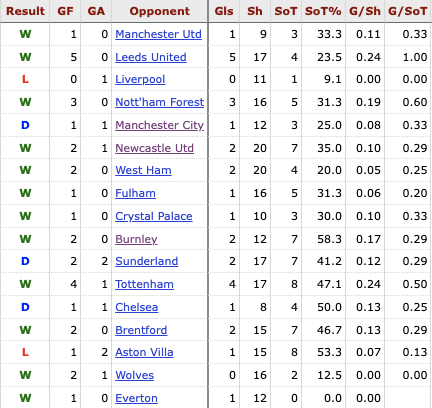
FBref: Arsenal Premier League 25/26 attacking stats vs opposition after 17 games played.
During the ‘good run’, they averaged around 1.7 xG per game. Since Sunderland, they’ve matched or exceeded that figure in all but two matches.
Whatever metric you prefer – xG, shots, big chances – there is no meaningful evidence that Arsenal have suddenly become blunt.
That doesn’t mean every performance has been fluent. The Wolves game, in particular, was clunky enough to test the eyesight – something clearly was off there.
But taken across that seven-match ‘bad stretch’, there’s no discernible drop-off in what they’re doing in the final third. The attack is pretty much functioning as it was before.
Arsenal defence: still the best in the league
Even defensively, Arsenal are still bordering on absurd levels of performance.
The Aston Villa game stands out as an obvious outlier. A makeshift back four, 15 shots conceded, and more than ten times the xG they allowed Everton. Over 20 percent of all the xG Arsenal have conceded this season came in that one game.
Take out that game, and the defensive numbers still look incredible.
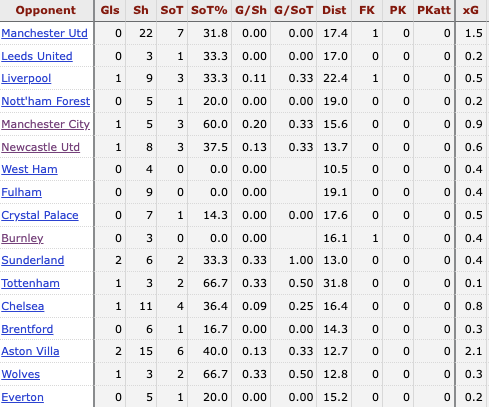
FBref: Arsenal Premier League 25/26 defensive stats per opposition after 17 games played.
In ten of their seventeen league games so far, Arsenal have allowed chances worth less than 0.5 xG. That’s not just good; it’s staggeringly small.
Across the season, they’re averaging roughly 0.5 xG conceded per game. Liverpool won the league last year conceding more than double that.
If defence really does win titles, Arsenal are operating in territory that should prove decisive.
Viktor Gyokeres and the goals debate
The conversation, inevitably, has drifted towards goals, and specifically Viktor Gyokeres.
Fifteen appearances, three open-play goals, and a £64 million price tag make him an easy target.
On the surface, the criticism is fair. You would expect more. But the reality is more nuanced than a simple finishing problem.
Gyokeres averages fewer than two shots per game. That’s well under half of Erling Haaland’s output and below the league average for strikers.
He isn’t missing glaring sitters because he’s not being put in those situations often enough. Which has led to accusations about his movement, his physicality, his suitability for the league.
But watch Arsenal closely, and you see a striker who often does the hard part.
Against Everton, there were several moments where Gyokeres read the space behind the centre-backs brilliantly, creating opportunities that weren’t taken.
This instance particularly stood out, where he opened up a lane for himself to attack, only for the ball to be worked back to Bukayo Saka instead:
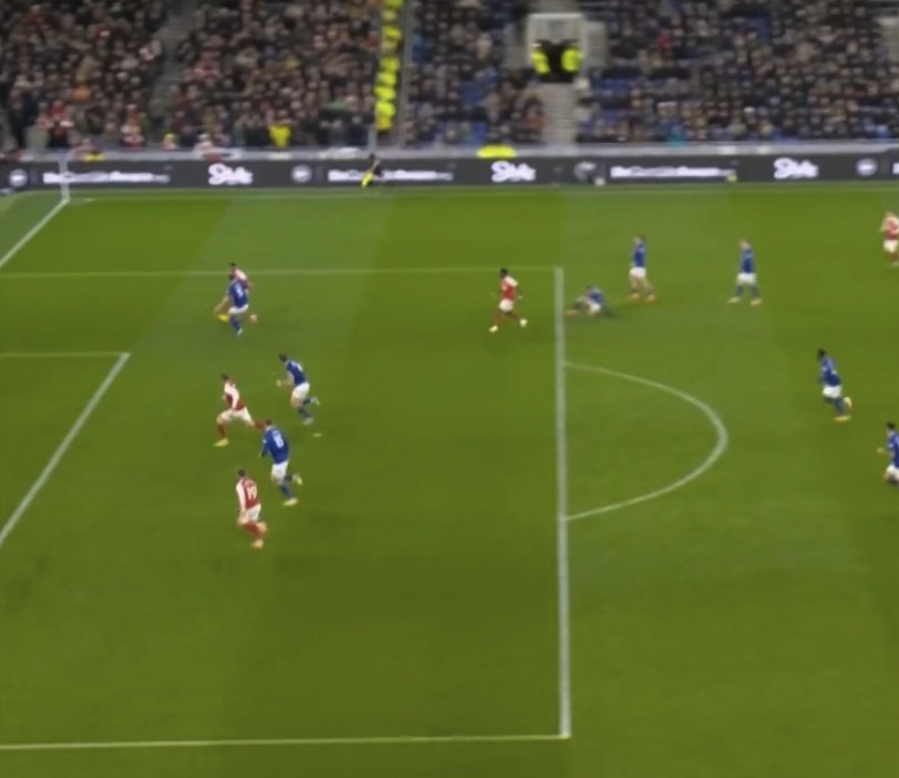
Saka’s shot is blocked, but if it goes in, nobody is talking about Gyokeres at all. Or better yet, everyone would be praising him for generating the space for Saka in the first place.
But moments like this seem to crop up in almost every game this season. He is a centre forward who relies on good service, which hasn’t been provided to him a great deal up to now.
But nonetheless, Arsenal are still a better attacking team with Gyokeres on the pitch. They create more of these chances with him.
The issue is less about his presence and more about the connection with his teammates.
Martin Odegaard’s role in Arsenal’s attack
Odegaard has found himself caught in the crossfire of the other side of the argument: that Arsenal aren’t creating enough.
The numbers, again, disagree.
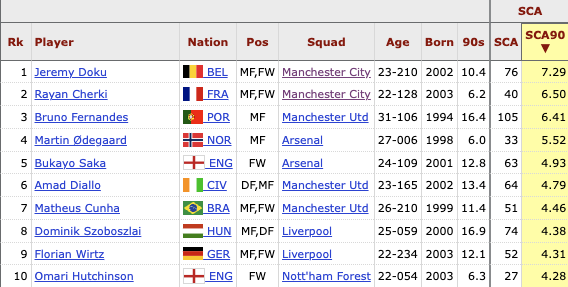
FBref: Premier League 25/26 shot-creating actions (SCA) per 90 after 17 games played.
He ranks fourth in the Premier League for shot-creating actions per 90 minutes, behind Bruno Fernandes – who takes every set piece for United – and Manchester City duo, Jeremy Doku and Rayan Cherki, who operate with far less defensive responsibility.
His key passes, carries into the final third, and penalty-area entries all paint the picture of a relentlessly productive playmaker.
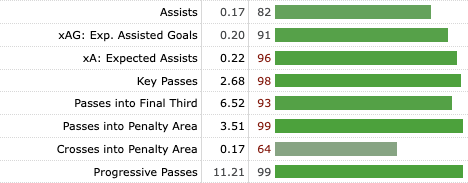
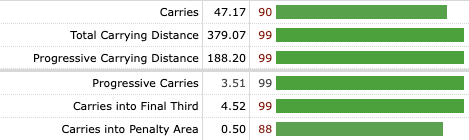
FBref: Martin Odegaard passing and carrying stats compared to positional peers after 17 games in the Premier League 2025-2026 season.
And yet, there are moments – like this from the Everton game – where he seems to delay or widen a pass that a centre-forward wants early and straight.

In a promising three-on-three, Gyokeres makes the run, Odegaard winds up holding the ball for too long before playing a pass to Gyokeres that is just too wide, and the chance dissipates.
It’s easy to frame that as a lack of chemistry.
But Odegaard gives Arteta’s side a huge tactical advantage. When Arsenal are leading in games, Odegaard drops deep. He wants the ball under pressure, not to gamble in the final third but to remove the opponent’s ability to press.
He beats the first line, carries through the second, and then recycles possession safely. That’s a massive reason why Arsenal can control matches the way they do.
The pass map, via Opta Analyst, from the Everton game tells the story:
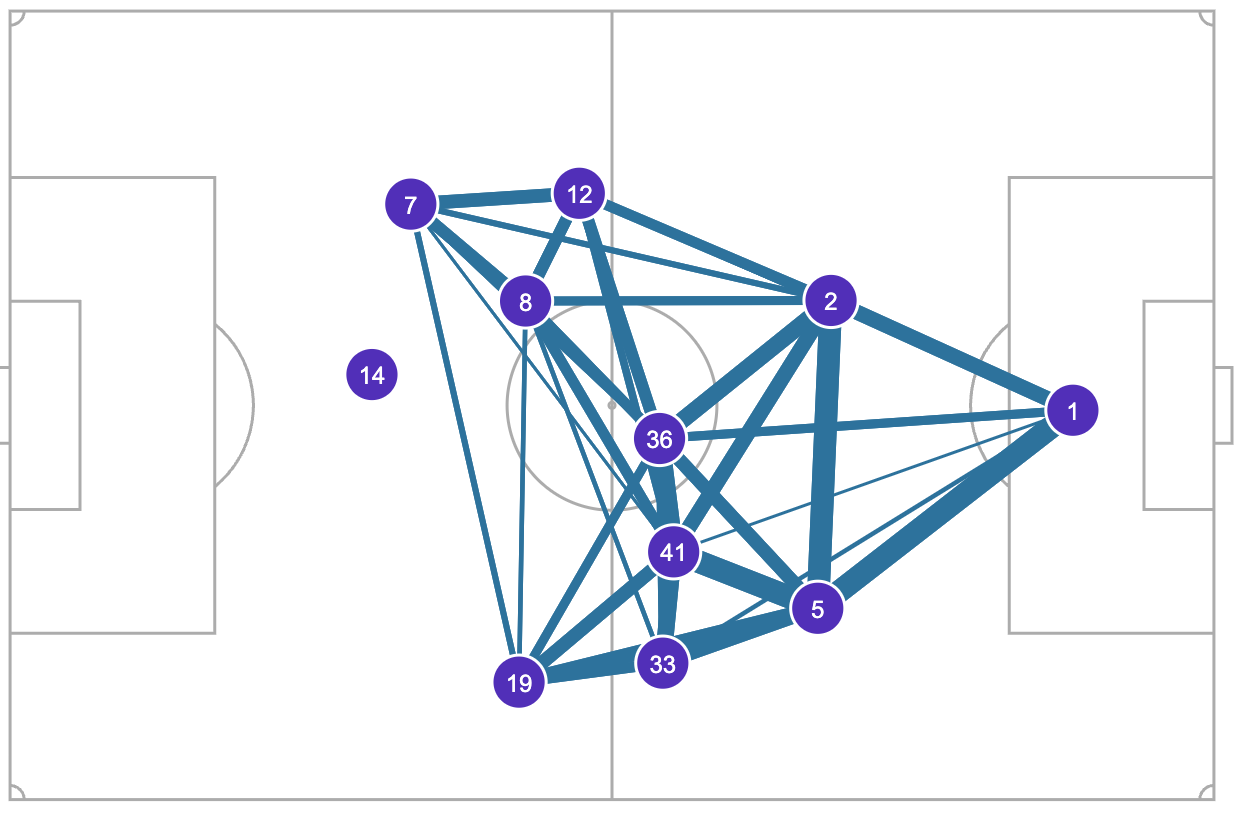
Opta Analyst: Arsenal passing network vs Everton in the Premier League, 20 December, 2025.
Notice how often Odegaard finds Saka, yet rarely finds Gyokeres. Whether that’s instruction or instinct, it’s clearly part of the plan.
Even when Gabriel Jesus came on and made similar runs, the safer, higher-percentage pass was still preferred.
And Arteta will undoubtedly tolerate some frustration in the final third if it means never losing control of a game.
Arsenal’s title strategy under Arteta
This is where Arsenal differ from recent champions. They are not built to score three or four on demand. Arteta is not that coach.
Instead, Arsenal are built around something else entirely: the near-total suppression of opposition chances.
Their approach is simple and ruthless. You will not create good chances against them. You will not see much of the ball near their box. And they will not make mistakes playing out from the back.
It’s because of this that they go into almost every game knowing that one or two goals will be enough to win.
When someone scores a screamer or benefits from a chaotic rebound, it makes everything feel fragile – like the wheels are falling off.
It amplifies the sense that Arsenal should be doing more. But this tension is baked in by design.
Since early November, amid injuries, brutal away fixtures, and low-block opponents, Arsenal averaged 1.3 goals per game. That usually isn’t title-winning form.
And yet, they only lost once. They avoided defeat in some of their toughest matches, and even the team that really opened them up, Aston Villa, needed a 95th-minute scramble to win.
Are Arsenal still favourites for the Premier League?
As things stand at Christmas, Arsenal sit top. And unless they suddenly forget how to defend this well, they are still strong favourites to win the Premier League.
Manchester City are hugely reliant on Erling Haaland, but should he stay fit and sharp, they can absolutely push Arsenal all the way. But Arsenal’s defining strength has not wavered either.
Every title-winning side is built around something, and Arsenal are built around the ability to suffocate games.
It’s not fun. It’s not calming. But it is consistent, and consistency is usually what decides leagues.
It might be an anxious way to win a title, but it still counts. And for now, Arsenal’s wobble looks more like part of the plan than the beginning of the end.

 Savinho to Spurs: City Must Now Decide on £60m Sale
- Meslier Joins Arsenal on a Free as Kepa Prepares to Exit
- Forest Demand Guaranteed British Record as City’s £120m Anderson Bid Looms
- Rashford Wants Barca or Bayern — Spurs Are Just the Fallback Option
- Tottenham Agree £52m Fixed Fee for Brighton’s Van Hecke
- Tottenham Threaten to Hijack Summerville as United’s Window Unravels
- Liverpool and United Circle Juventus’s Thuram at €50m
- Arsenal agree personal terms with Manu Koné in €45m Roma deal
- Man United Target Summerville and Fernandes in £130m West Ham Double Deal
- Nico Paz Set to Stay at Como as Real Madrid Step Back