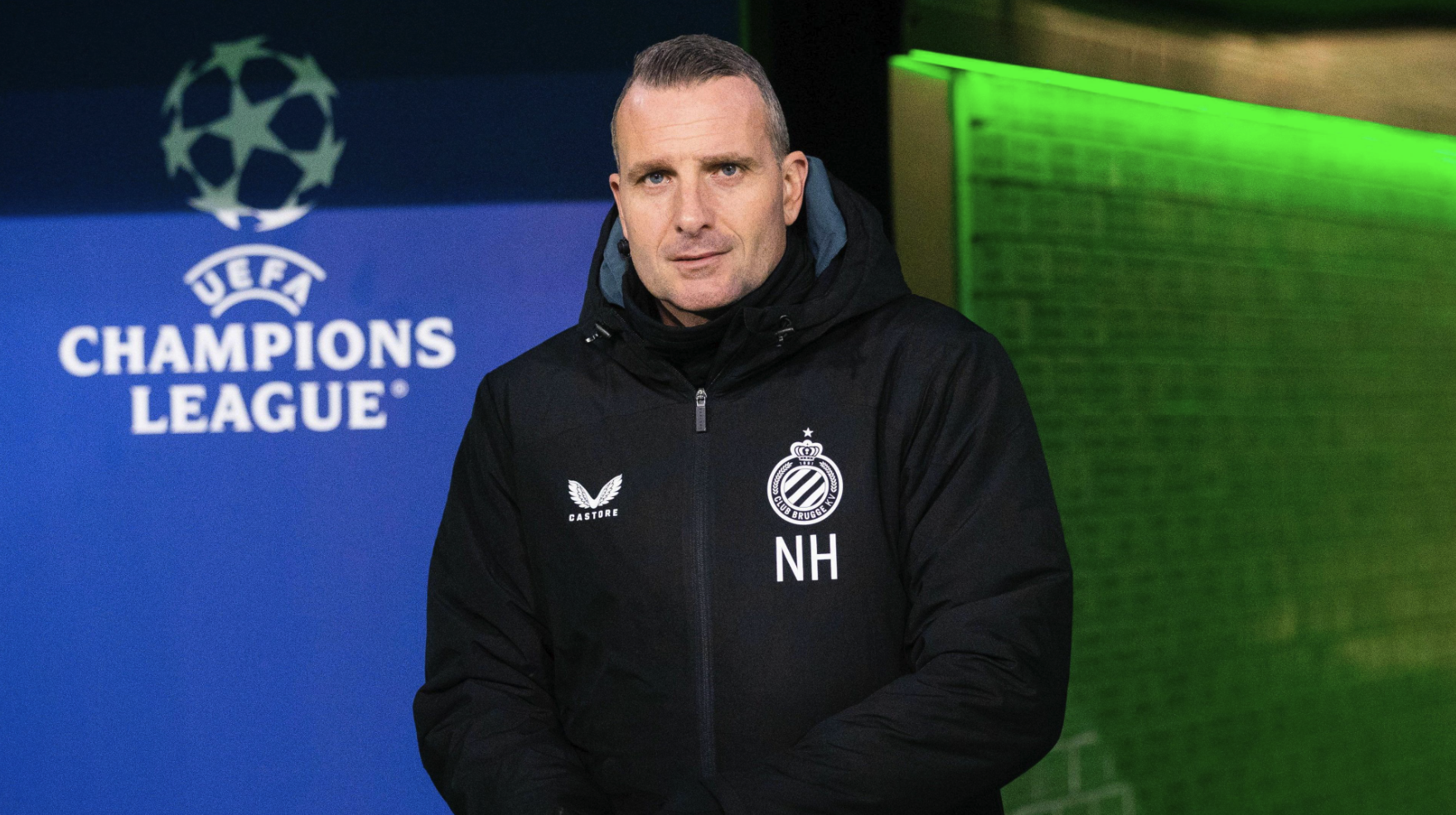
After Club Brugge’s thrilling 3-3 draw with Barcelona in the Champions League, attention has turned to the man behind the touchline. So, who is the Club Brugge manager, and how did he guide one of Belgium’s biggest clubs to challenge Europe’s elite?
That man is Nicky Hayen, and his story isn’t one of instant success, but of steady growth, smart learning, and tactical maturity that’s now making him one of Europe’s most intriguing young managers.
Nicky Hayen – Club Brugge Manager
If you were to build the perfect modern coach, you’d probably base them around adaptability, a strong work ethic, and the ability to recover from early setbacks. That’s Nicky Hayen in a nutshell.
At just 45, he’s already shown that rare blend of tactical flexibility and relentless commitment that separates good coaches from great ones.
After leading Club Brugge to an unexpected Champions League knockout stage appearance last season – and another impressive result in matchday four against Barcelona – Hayen has established himself as one of the most intriguing young managers in European football.
But before we talk tactics, let’s answer the key question: who is Nicky Hayen, and how did he reach this level?
Nicky Hayen Background
Born in Sint-Truiden, Belgium, in 1980, Nicky Hayen spent much of his playing career with his hometown club, making 243 appearances before moving around Belgium and the Netherlands. When his playing days wound down, he transitioned into coaching – though it didn’t all go smoothly.
In 2013, he was promised a role at Antwerp, only to end up at third-division Dender as player-coach, a job that lasted just six months. It looked like both his playing and coaching careers were over before they’d really begun.
Then came a lifeline. His former mentor Marc Brys was coaching in Saudi Arabia and invited him to join Najran as assistant. Hayen later followed Brys to Al-Raed, gaining vital experience abroad before returning home with a broader tactical education.
Back in Belgium, he coached at KVK Tienen, ASV Geel, and Berchem Sport, before taking charge of youth development at Sint-Truiden, the club where it all began. He briefly stepped in as caretaker manager, but after six matches, he was dismissed.
It wasn’t until his spell at Waasland-Beveren – and later Haverfordwest County in Wales – that his coaching philosophy really started to form.
In Wales, Hayen transformed a relegation-battling side into one of the most attacking teams in the league. That turnaround earned him attention back home, and soon, Club Brugge came calling.
Initially appointed to oversee Club NXT, the reserve side, Hayen impressed so much that he was promoted to the first team. When Brugge parted ways with Ronny Deila, Hayen took over as caretaker and led them to the Belgian title through the playoffs, earning the permanent job soon after.
Since then, he’s guided Brugge to domestic and European success, including that knockout-stage run in last season’s Champions League and a second-place league finish.
https://www.youtube.com/watch?v=lOlQAz0ZVuE
Nicky Hayen Tactics
Tactically, Nicky Hayen mixes structure with adaptability. His preferred base is a 4-2-3-1, but he adjusts it frequently depending on the opponent and game state.
Against low blocks, he pushes full-backs high and introduces an extra attacking midfielder to overload central areas. Against stronger sides like Barcelona, he shifts into a compact 4-4-2, prioritising defensive shape and counter-attacks.
Hayen’s sides don’t press constantly; instead, they use targeted pressing triggers, forcing turnovers in specific zones. He occasionally employs a hybrid centre-back who steps up to create numerical superiority in the midfield, taking a more athletic defender who’s willing to create that mismatch in the centre of the pitch.
Offensively, his Club Brugge teams thrive in transitions, launching fast, direct counters from recovered possession. He encourages quick switches of play to exploit vacated spaces, which is especially effective against compact mid-blocks, and loves using width through adventurous full-backs and wingers.
What stands out most though is his tactical flexibility. When facing teams with intense high presses, like Atalanta or Leverkusen, Brugge go direct with long diagonals. Against possession-dominant sides such as Celtic or Benfica, Hayen’s men sit compact, waiting to strike in transition.
This match-to-match flexibility has been a huge factor in why Club Brugge has been able to maintain their competitiveness across a myriad of competition levels, and it could make Hayen very attractive to a club who plays a wide range of competition – hence the recent Celtic links.
Nicky Hayen Management Style
Beyond tactics, Nicky Hayen is admired for his work ethic and man-management. He describes himself as a “workaholic” – a description his players happily confirm.
Not known as a yeller, he offers a measured and stoic approach to leading his team. He gets higher remarks for his man management, making a point of understanding his players from top to bottom in his squad.
Former mentor Marc Brys once said of Hayen, “He’s a thinking coach. He doesn’t make rash decisions. Players speak highly of him, and that’s the best compliment he can get.”
Hayen adapts his system to fit the strengths of his squad rather than forcing players into rigid roles, a trait that makes him ideal for clubs prioritising flexibility and player development.
Nicky Hayen Next Club
Hayen’s lack of success before Club Brugge may be exactly what allows the Belgian giants to keep him around for another year.
That Champions League run alone may open up some doors to him, most likely in Germany, which has a natural connection to Belgium and would provide a decent transition.
Of course, the list of managers who started in Belgium and then went on to big success is not long. Right now, it’s basically just Vincent Kompany, who had a much more distinguished playing career, former Club Brugge manager Philippe Clement, who most recently managed Rangers; and Adi Hutter, who had a few German stints before his most recent run as Monaco manager.
But the recent success of managers like Arne Slot has proven that you can go from a solid track record at some of these mid-tier countries and jump right to the big time and have success.
So is Hayen ready to make that jump? How much longer does he need to prove his worth at Club Brugge? Does he need to repeat this level of success in the Champions League and win another league title to have somebody take a shot at him?
Time will tell, but European clubs will certainly be watching him closely.

 Savinho to Spurs: City Must Now Decide on £60m Sale
- Meslier Joins Arsenal on a Free as Kepa Prepares to Exit
- Forest Demand Guaranteed British Record as City’s £120m Anderson Bid Looms
- Rashford Wants Barca or Bayern — Spurs Are Just the Fallback Option
- Tottenham Agree £52m Fixed Fee for Brighton’s Van Hecke
- Tottenham Threaten to Hijack Summerville as United’s Window Unravels
- Liverpool and United Circle Juventus’s Thuram at €50m
- Arsenal agree personal terms with Manu Koné in €45m Roma deal
- Man United Target Summerville and Fernandes in £130m West Ham Double Deal
- Nico Paz Set to Stay at Como as Real Madrid Step Back