How will Birmingham fill their new stadium? A look at attendances, demand, long-term plans and whether a 62,000-seat venue is realistic.
Birmingham City’s plans for a new 62,000-seater stadium have generated both excitement and scepticism in equal measure.
The design is bold, unmistakably Birmingham, and unlike anything else in English football, but the conversation keeps circling back to whether they’ll be able to fill a ground so big.
So, can they?
Can Birmingham Sell Out A 62,000 Stadium?
It’s the first thing most people asked when the renderings dropped. Birmingham have never averaged close to 62,000 in their history, with their current St Andrew’s stadium holding a capacity of just over the 29k mark.
During last season’s dominant League One campaign they averaged around 26,000 – an excellent number for the third tier but still miles from Premier League super-club territory.
It still leaves a gap of 36,000 extra seats compared to their strongest recent attendance. Even if the Blues stabilise in the Premier League and rebuild momentum, that is a jump few clubs in England have ever made.
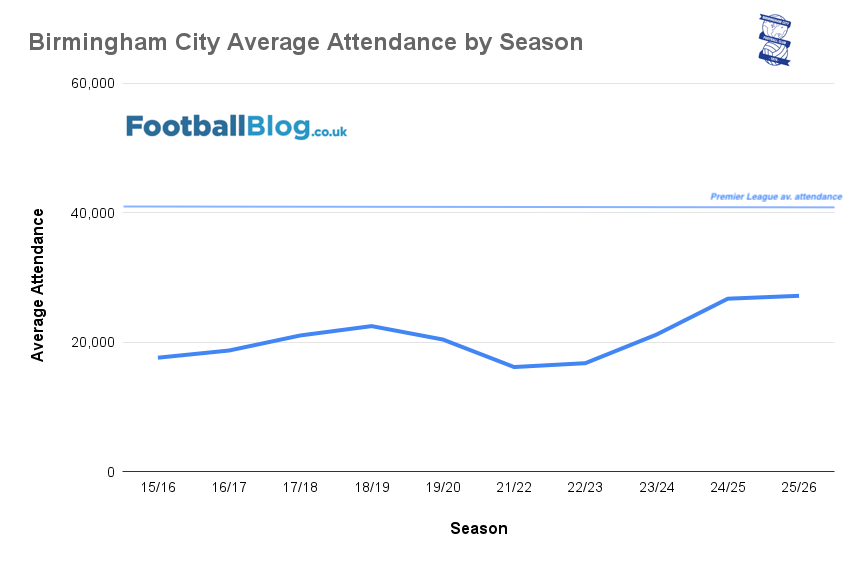
Birmingham City’s average attendance by season. 2020-21 season excluded due to numbers affected by COVID-19 pandemic. Straight light-blue line represents average Premier League attendance across all 20 clubs for the 2024-25 season. Source: Transfermarkt.
Even if you go back to the 2010-11 season – the last time they were in the Premier League – St Andrew’s had an average attendance of just over 25,000.
Birmingham City need to more than double the best attendance they’ve pulled in a generation. Add in regional competition – Aston Villa, Wolves, West Brom – and the sceptics argue there simply aren’t enough fans to go around.
Some comparisons aren’t flattering either: Tottenham’s new stadium hovers around the 60,000 mark with European football; Villa draw around 40,000 with a stronger modern history.
This is not meant as a dig – every club is allowed to dream big, and Knighthead clearly are.
Thomas Heatherwick being involved is great, the design is ambitious, and the whole “twelve chimney towers” thing will be a magnificent sight to behold.
But for a club whose average gate has traditionally hovered around 20k, it’s an extraordinary leap of faith. It’s optimistic. It’s ambitious. It’s American-owner-energy turned up to 11. It’s also the sort of move that invites a gentle, eyebrow-raised “Are you sure, lads?”
But Birmingham argue the numbers don’t tell the current story.
https://www.youtube.com/watch?v=_bUAVOxVp7A
Birmingham Season Ticket Waiting List
If you’re trying to work out how Birmingham will fill their new stadium, the season-ticket waiting list is the closest thing we have to hard evidence.
St Andrew’s in its restricted state still sells out every week. More interesting, though, is what can’t get through the gates: more than 12,000 supporters are sitting on the season-ticket waiting list.
For comparison, when Tottenham were at the old 36,000-seat White Hart Lane, they had a season-ticket waiting list of enough additional people to fill their new 62,000-seater.
Now, of course, Birmingham aren’t quite Tottenham in terms of global reach, but the underlying logic is the same: if that many people want to get in now, imagine how many would turn up once the roof stops leaking and you can actually see the pitch from every seat.
And then there’s last season’s Wembley factor. Birmingham’s ticket demand for the Vertu Trophy Final last season passed 75,000.
That obviously dwarfs their week-to-week attendance and suggests that there’s a much larger pool of supporters who will join in whenever the moment feels big enough.
Essentially, that’s what the owners are banking on. Build something modern, something spectacular, and those occasional fans become regulars – and those regulars become season-ticket holders.
Is Birmingham City’s New Stadium Too Big?
This is where the conversation opens up. The Powerhouse isn’t designed solely as a venue for just football.
Knighthead have been clear that the £1.2–1.5bn project is part of a wider Sports Quarter built to operate 365 days a year, with:
-
a retractable roof
-
a moveable pitch
-
NFL compatibility
-
concerts, boxing, large-scale events
-
a multi-venue entertainment district
In that context, 62,000 isn’t the weekly football expectation, but rather it’s the stadium’s maximum commercial flexibility.
They will argue that, football-wise, Birmingham don’t need to sell out 62,000 every Saturday. A consistently full lower bowl with steeper stands that amplify atmosphere would create noise and identity even at 45,000.
The remaining capacity is there for surges: derbies, promotion pushes, Premier League peaks, cup runs, big events.
Knighthead’s argument is that the demand grows with the ambition. By 2030 they project £150m+ annual revenue, positioning Birmingham as a Premier League mainstay rather than a Championship yo-yo.
And they’re building the infrastructure to force that reality into existence.
https://www.youtube.com/watch?v=tXflllKXuEc
How Will Birmingham Fill Their New Stadium?
The question is less about now and more about who Birmingham expect to be by 2030 and beyond. Their strategy isn’t a short-term attendance gamble but rather a long-term scaling project.
If Birmingham can reach Premier League stability, maintain the commercial growth their owners have already initiated, and embed themselves as the anchor of a regenerated East Birmingham district, then 62,000 might not be delusional after all.
If they don’t? Then yes, critics will say it’s just Stadium MK with chimneys.
But the owners have made their bet and it feels like a large part of the fanbase is willing to bet with them.
Right now, Birmingham are building a stadium not for the version of themselves that slipped into League One, but for the version they expect to become.
In the end, whether you think Birmingham fill their new stadium is a matter of whether you believe Birmingham City’s project works. Knighthead clearly do.
It’s bold. It’s brave. And it’s slightly mental. But you can’t deny the ambition.

 Real Madrid reportedly strike £120m agreement for Enzo Fernandez
- Paul Scholes Says Marcus Rashford Should Make Shock Arsenal Move
- Romano reveals Man Utd plan after Ederson as £50.5m player heads for exit
- Liverpool Stunned as Ibrahima Konate Was Open to Man Utd or Chelsea Move
- Alex Scott Contract Delay Puts Man Utd and Chelsea on Alert
- Rafael Leao Offered to Arsenal as Man Utd Twist Changes the Picture
- Arsenal line up Julian Alvarez talks as Barcelona battle hands Gunners major hook
- Andoni Iraola gives Liverpool ‘yes’ as new Reds era begins with backroom team revealed
- PSG Cool Julián Álvarez Interest, Leaving Atlético Madrid Clear Path
- Arsenal, Chelsea or Man City? Ranking the Best Destinations for Rafael Leão