A detailed look at why Man City are struggling, from Pep Lijnders’ new pressing ideas to a drop in physicality and output across the squad.
Manchester City are not used to this. Nine games into the Premier League season, they sit fifth, level on points with Manchester United and six adrift of leaders Arsenal.
They’ve already lost three league matches – to Tottenham, Brighton, and Aston Villa – and, except for their extraordinary striker, they look rather ordinary.
This is still Pep Guardiola’s Manchester City. The possession structure remains familiar, the automatisms still recognisable. But the sharp edges have dulled.
And as the new coaching ideas bed in under Pep Lijnders, Jurgen Klopp’s right-hand man who was brought in to evolve City’s defensive structure, the cracks have begun to show.
Man City Structure: In Possession
In possession, nothing looks particularly alarming. On paper, it’s textbook Guardiola: a 4-3-3 that becomes a 3-2-5 as John Stones steps into midfield, giving City control and progression through the thirds. Structurally, it all still makes sense.
But structure only works if the individuals executing it are elite – and that’s where City’s problems begin.
Compare this iteration of City to the treble-winning side from two years ago. Gianluigi Donnarumma is less assured with the ball than Ederson ever was. Oscar Bobb and Savinho are bright prospects but inconsistent. Phil Foden, as good as he can be, is not Kevin De Bruyne.
The drop-off isn’t dramatic in isolation, but it’s cumulative. City’s output has nosedived because the margins that used to be filled by De Bruyne’s power, Mahrez’s composure, or Grealish’s robustness now belong to players who are more 5-a-side flair than 11-a-side killers.
They’re tidy, technical, and lightweight. And in a Guardiola system that relies on control, that lack of physical edge hurts, particularly compared to a team like Arsenal.
A Softer Man City
City’s attack has always been about control. But in previous seasons, that control was gained by force – by players who could win duels, dominate transitions, and impose themselves.
Now, City look… soft. Without De Bruyne’s power or Mahrez’s technical bravery, the midfield feels flimsy. Bobb, Savinho, and even Foden are wonderful talents, but none provide the same robustness out of possession. That’s left City struggling to win the second balls that once suffocated opponents.
It’s not that Guardiola’s ideas have suddenly stopped working. It’s that the personnel executing them aren’t suited to the physical demands of his control-based style.
Man City Out of Possession: The Lijnders Experiment Is Backfiring
The most noticeable change this season is their defensive structure. Pep Lijnders’ arrival as part of the coaching staff has seen City transition from their familiar man-to-man pressing system to a more zonal approach.
On paper, it’s progressive. In practice, it’s chaotic.
Against Aston Villa, the flaws were glaring. Bernardo Silva admitted as much post-match, describing how City pressed poorly.
"We were really bad defensively"
Bernardo Silva after Manchester City's unbeaten run came to an end after a 1-0 loss against Aston Villa. pic.twitter.com/hpUoHXXmGQ
— Sky Sports News (@SkySportsNews) October 26, 2025
Their 4-1-5 shape, designed to suffocate the opposition’s build-up, often left huge spaces in midfield. The front five pressed without coordination; the midfield screened instead of jumping; and Villa repeatedly played through the gaps.
The problem isn’t the idea itself. Zonal pressing can work brilliantly when executed correctly. It’s that this group of players simply aren’t wired for it.
City’s current midfielders and wingers don’t have the intensity or physicality to press and recover as a collective. When one player jumps late or fails to block a lane, the whole system collapses.
That’s exactly what happened at Villa Park: confusion, half-presses, and open lanes everywhere.
Why Are Man City Struggling?
Under Lijnders, City now press more horizontally, aiming to cover zones rather than engage man-to-man. But Guardiola’s best teams – from Barcelona to Bayern to his peak City sides – were built on the opposite: direct, vertical pressure from central areas.
When City press well, they win the ball high. When they don’t, their mid-block becomes a liability. They drop into a 4-5-1 but keep a high line, leaving acres of space behind Rodri. Without pressure on the ball, that high line is suicidal. Aston Villa and Brighton both exploited it with simple passes in behind.
In short:
-
City’s pressing triggers are confused.
-
Their energy levels are inconsistent.
-
Their possession losses are no longer protected by elite counterpressing.
This isn’t just a coaching issue; it’s to do with personnel. City are still trying to play like a physically dominant team with technically refined but less aggressive players.
Why Is Haaland Thriving?
The irony is that Erling Haaland is thriving anyway.
The more chaotic City become, the better he looks. More turnovers, more transitions, more space – this is where Haaland’s power and movement shine.
In fact, Haaland’s goals are carrying Man City, having scored over 65% of his team’s goals across all competitions this season.
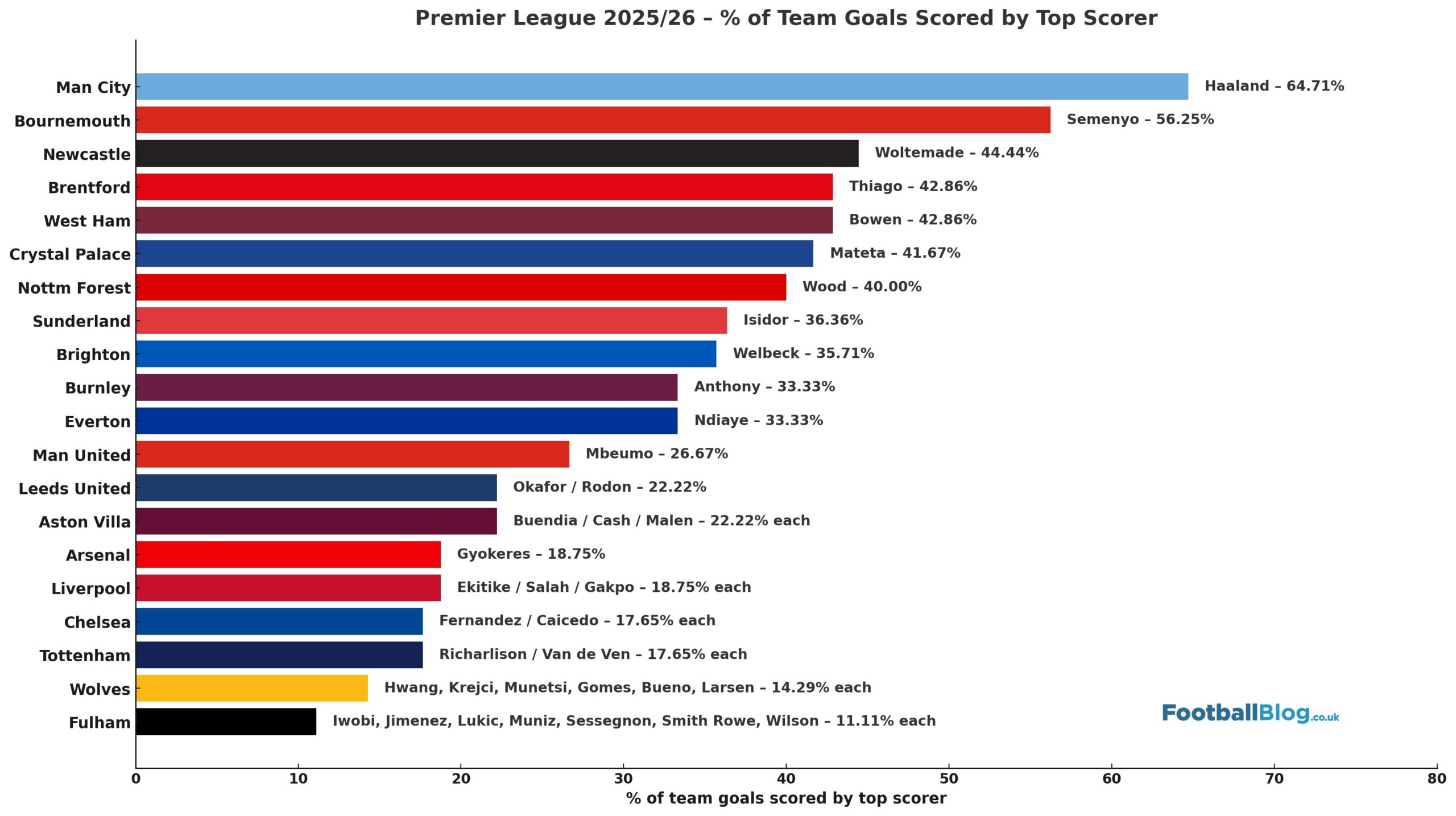
A graph displaying the percentage of goals scored by each Premier League team’s top scorer so far this season
But while his numbers sparkle, the rest of City wither. The more the game turns transitional, the further they drift from what Guardiola built his empire on: control.
Can Pep Guardiola Fix Man City’s Issues?
Pep Guardiola has rebuilt teams before. He’s reinvented fullbacks, midfielders, and goalkeepers. But this rebuild feels different.
The Lijnders experiment may yet pay off, but right now, City look like a side caught between two pressing philosophies, with players unsuited to either extreme. They remain beautiful with the ball but brittle without it.
Maybe this is just the messy middle before Pep births another unstoppable monster. But for now, they look oddly beatable.
Unless Guardiola can rediscover the physical and mental edge that made his sides unplayable and reassert his own pressing principles, Manchester City will remain a possession machine with a glass jaw.
TL;DR
-
Still elite with the ball, but lacking cutting edge and robustness.
-
Zonal pressing under Lijnders not working with this squad.
-
Less physicality and output from wide and midfield areas.
-
More vulnerable defensively due to poor pressing coordination.
-
Haaland thriving individually, but City regressing collectively.

 Saliba’s Back Injury: No Surgery, No Return Date as Arsenal Plan Around Absence
- Real Madrid Close to Personal Terms With Rodri as City Talks Loom
- Emery Reunion Drives Villa’s Move for £65m-Rated Jackson
- PSG’s £120m-Plus Barcola Demand Puts FSG’s Ambition to the Test
- Savinho to Spurs: Why the £60m Man City Deal Looks Done
- Inter Eye Cristian Romero But €50m Fee and Wages Create Major Hurdles
- Trafford the Only Keeper Target as Leeds Stall on Charles and Chase Brandt
- Argentina Face FIFA Investigation After World Cup Final Confrontations
- Guimarães Bid Incoming and Williams Opens Door in Arsenal’s £167m Push
- Ferran Torres Transfer: Liverpool and PSG Compete for Barcelona Forward