Ruben Amorim insisted following Manchester United’s 1-1 draw at Leeds on Sunday that he came to Old Trafford to be a manager, not a coach.
Amorim has since been sacked by Man United, bringing his 420-day spell at Old Trafford to an end.
But what was his official job title? And what is the difference these days between the role of a manager and that of a head coach?
What did Ruben Amorim say about his job title at Man United?
Amorim’s explosive rant about his position following Sunday’s draw with Leeds came after a reporter asked him to clarify the comments he made a week earlier. Those earlier remarks had seen Amorim appear to partly blame the club’s recruitment structure for his lack of success in Manchester to date.
“If we have to play a perfect 3-4-3, we need to spend a lot of money and we need time,” Amorim said late last year, followed by: “I’m starting to understand that that is not going to happen. So, maybe I have to adapt.”
Amorim had refused the opportunity to clarify those comments in his press conference before Sunday’s game, but he spoke much more freely on the subject after the match.
“I notice that you receive selective information about everything,” said a fired-up Amorim. “I came here to be the manager of Manchester United, not to be the coach of Manchester United. That is clear.
“I know that my name is not [Thomas] Tuchel, it’s not [Antonio] Conte, it’s not [Jose] Mourinho, but I’m the manager of Manchester United and it’s going to be like this for 18 months or when the board decides to change.
“That was my point. I want to finish with that. I’m not going to quit. I will do my job until another guy is coming here to replace me.”
When asked whether he felt the club was failing to deliver on previous assurances, Amorim added: “I just want to say I’m going to be the manager of this team, not just the coach. I was really clear on that.
“That is going to finish in 18 months and then everyone is going to move on. That was the deal. That is my job, not to be a coach.
“If people cannot handle the Gary Nevilles and the criticisms of everything, we need to change the club.
“I just want to say that I came here to be the manager of Manchester United, not to be the coach.
“Every department – the scouting department, the sporting director – needs to do their job. I will do mine for 18 months, and then we move on.”
Amorim had been at Old Trafford since November 2024. He took charge of 63 matches, winning 24, drawing 18 and losing 21. United finished 12th in the 2025 Premier League calendar year table, and Amorim admitted that Man United were underachieving during his time in charge.
So… was Ruben Amorim the manager of Man United or the head coach?
Despite Amorim’s repeated insistence that he came to Manchester to be a manager rather than a coach, his official job title was clear.
He was appointed as head coach of Manchester United. That was made explicit on day one, when the club announced his arrival in an official statement.
The announcement was titled: “Man Utd appoint Ruben Amorim as new head coach”, while the opening line read: “Manchester United is delighted to announce the appointment of Ruben Amorim as Head Coach of the men’s first team, subject to work visa requirements.”
That statement went on to use the word “coach” twice more, while there was no mention of “manager”.
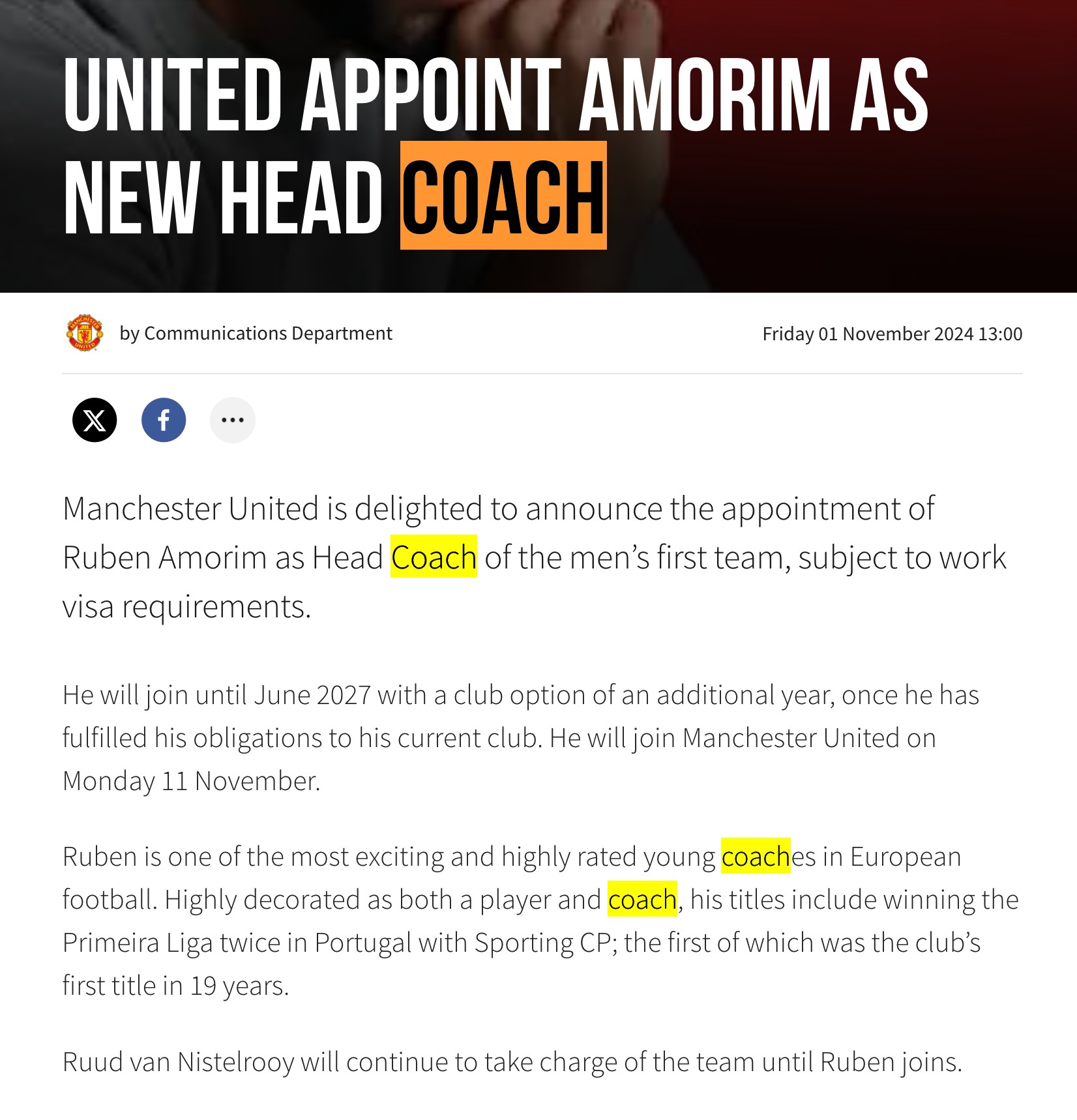
Manchester United used the word “coach” four times in their club statement when Ruben Amorim was hired, while there was no mention of him being the “manager”
The language used by United to announce Amorim’s appointment was very different from when previous boss Erik ten Hag was hired in 2022. The Dutchman was welcomed in a statement that led with the title: “Manchester United appoints Erik ten Hag as manager”.
What is the difference between a manager and a head coach?
In modern football, the distinction between a manager and a head coach is less about status and more about scope.
A head coach is typically responsible for first-team matters on the pitch: training sessions, tactical preparation, matchday decisions and player development. Recruitment, contract negotiations and long-term squad planning are usually led by a sporting director or recruitment department, with the head coach contributing but not holding final authority.
A manager, by contrast, traditionally operates with a broader remit. Alongside coaching responsibilities, managers have historically overseen recruitment strategy, influenced transfer decisions and played a more central role in shaping the club’s football identity across multiple departments.
That traditional model has become increasingly rare at elite level. Most Premier League clubs now employ head coaches within a wider footballing structure. Arne Slot at Liverpool, Pep Guardiola at Manchester City and Thomas Frank at Tottenham Hotspur all carry the head coach title, reflecting a model where responsibility is shared rather than centralised.
Enzo Maresca was also a head coach at Chelsea prior to his departure last week. Maresca left Chelsea with a record of 55 wins in 92 games.
There are still exceptions. Mikel Arteta is officially Arsenal’s manager, having initially been appointed as head coach in December 2019 before his title – and authority – was upgraded the following year. His role now extends well beyond the training pitch, giving him greater influence over recruitment and long-term planning.
This context helps explain Amorim’s frustration — frustration that ultimately contributed to his dismissal.

 Savinho to Spurs: City Must Now Decide on £60m Sale
- Meslier Joins Arsenal on a Free as Kepa Prepares to Exit
- Forest Demand Guaranteed British Record as City’s £120m Anderson Bid Looms
- Rashford Wants Barca or Bayern — Spurs Are Just the Fallback Option
- Tottenham Agree £52m Fixed Fee for Brighton’s Van Hecke
- Tottenham Threaten to Hijack Summerville as United’s Window Unravels
- Liverpool and United Circle Juventus’s Thuram at €50m
- Arsenal agree personal terms with Manu Koné in €45m Roma deal
- Man United Target Summerville and Fernandes in £130m West Ham Double Deal
- Nico Paz Set to Stay at Como as Real Madrid Step Back