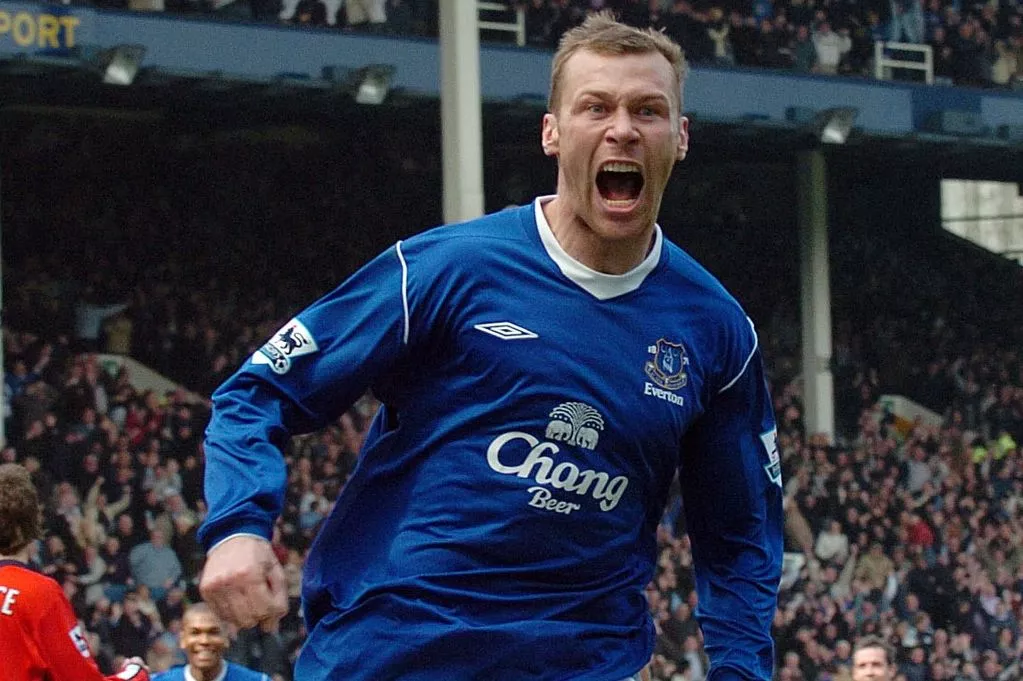
Mention Duncan Ferguson and a few things immediately spring to mind.
Everton, obviously. Headed goals. The No 9 shirt with which Ferguson’s name became synonymous across 10 seasons at Goodison Park. The “bruise brothers” partnership he formed with fellow striker Kevin Campbell.
And then, of course, there are the red cards, eight of which were brandished at the 6ft 4in Scot, affording him the dubious distinction of sharing a Premier League record with former Arsenal midfielder Patrick Vieira and fellow Everton alumnus Richard Dunne.
What you don’t immediately think of, however, is the warmth of character, unflinching honesty and self-deprecating humour that shone through in the 53-year-old’s punditry turn on Sky Sports’ Monday Night Football, where Ferguson reflected on past glories and transgressions and lifted the lid on future ambitions.
Foremost among the latter was a dream to manage Everton, a role he has twice previously performed on a caretaker basis, most memorably following the dismissal of Marco Silva in December 2019.
What did Duncan Ferguson say on Sky Sports about managing Everton?
Ferguson’s first match in the Goodison dugout was a thing of raucous beauty. His unflinching passion and intensity on the touchline, where he celebrated two of the goals in a 3-1 victory over Chelsea by grabbing the nearest ballboy in a bear hug, mirrored the mood in the stands as Everton, led by one of their own, moved clear of the relegation zone.
“It was incredible, what a feeling,” said Ferguson, who won the FA Cup with Everton in 1995. “I wish I could re-live that over and over again.”
Draws against Manchester United and Arsenal would follow, providing Everton with a platform for safety before Carlo Ancelotti took up the reins. While no one could quibble with that appointment, the Scot was disappointed not to get the job ahead of Frank Lampard after once again stepping into the breach when Rafael Benítez’s short-lived tenure came to an end in January 2022.
“Going with results I got, I think I could have got the chance, but of course Carlo Ancelotti was sacked from Napoli,” recalled Ferguson of the first of those spells. “I thought I could’ve got a wee sniff at it there, my record was good, but unfortunately it was not to be and they went a different way.
What did Duncan Ferguson say on Sky Sports about wanting to manage Everton?
“I still want to be on that touchline for Everton. I’ve still got dreams. But I’ve got to get back into football, get back into management – that’s my dream.
“Hopefully I’ll get another chance, hopefully I’ll get back in. I still want to manage, I still think I’ve got a lot to offer. I’ve got a track record for it.
“I’ve come all the way through Everton’s academy, developed a lot of players. I’ve worked with the best and as a coach, as a manager, I’ve developed players as well. I like working with young players, so hopefully I’ll get a chance again.”
By now, nobody is under any illusions about the value of an appearance on Monday Night Football for a player or manager who unexpectedly finds themselves with time on their hands. It is a chance to get out there, to put yourself back in the shop window and have your achievements unapologetically celebrated in front of a large audience. It is also an opportunity to send a not-so-coded signal that you’re open to work; if you happen to have a book to promote – Ferguson’s autobiography Big Dunc was published in May – so much the better.
What other teams has Duncan Ferguson managed?
Yet there was an obvious sincerity about Feruson’s desire for a return to the dugout, one born of a sense of unfinished business following unsatisfactory spells in charge of Forest Green Rovers, then of League One, and Inverness Caledonian Thistle, who were in the Scottish Championship when he arrived. Both clubs were bottom of their respective leagues when he arrived; both went on to be relegated.
“I picked two really tough jobs, two jobs with teams that were at the bottom of the league,” said Ferguson. “And I lost my job [at Inverness] through administration, so I had a bit of a bad break on that one.”
Why did Duncan Ferguson go to prison?
He has known his share of bad breaks. One of the more notable came early in his career, when he was sentenced to three months in Glasgow’s Barlinnie prison after headbutting Raith Rovers defender John McStay in a match for Rangers, where he spent just over a season between 1993 and 1994.
Ferguson was later convicted for assault and, since it was his third such brush with the law – fined for headbutting a police officer in February 1991, he had also struck a man on crutches during an incident in Edinburgh two years later – an appeal proved unsuccessful. The outcome of what one of the judges described as a “tragic case” – Ferguson was just 23 at the time – rankles to this day.
“It was a tough time in my career, going to Barlinnie,” said Ferguson, who was jailed in October 1995 and went on to spend 44 days behind bars. “It wasn’t an open jail, it was a real tough prison. It wasn’t easy going in there: middle of Glasgow, I’d played for Rangers, the prison was split Rangers-Celtic. So it wasn’t an easy time of my life.
“I was young, I was a bit daft at the time. But it was still unfair, what happened to me. I don’t think anybody would agree that I should be getting put into prison for three months for something that happened on the football pitch.”
Why did Duncan Ferguson win so few caps for Scotland?
In addition to the sobering realities of life inside, described in graphic detail in his book, Ferguson was banned for 12 matches by the Scottish FA. It soured his relations with the national team to the point where he never represented his country.
“I think about it nearly every day, what could have been,” said Ferguson, who earned his first cap after making waves at boyhood club Dundee United. “I gave up playing for my country, I only played seven times, I never scored a goal for them.
“I was a bit pig-headed to be honest, when I was younger. I thought it was unfair, getting a 12-game ban, getting a prison sentence.
“When I came out of prison I thought maybe they could have [said] I didn’t need to serve that ban. But the Scottish FA pushed for the ban when I came out of prison, and I thought that was unfair.”
Was Duncan Ferguson’s transfer from Dundee United to Rangers a British record?
The £4m fee Rangers paid to extract Ferguson from Tanndice represented a British record at the time – it is indicative of how little the game in Scotland has changed that it remains the 10th highest transfer outlay in the Ibrox club’s history – and he has admitted the price tag weighed heavily.
Yet for all his sense of failure at the time, he would go on to become a cult figure at Goodison Park after leaving Rangers, scoring 72 goals in 273 appearances either side of a £7m transfer to Ruud Gullit’s Newcastle. The latter move was marred by injury, a perennial theme of Ferguson’s career.
Given his disciplinary issues and aggressive style on the pitch – not to mention the fact that he once hospitalised a burglar foolish enough to break into his Merseyside home – Ferguson has inevitably acquired a reputation as a tough guy. One TV appearance is unlikely to change that, yet it will undoubtedly have upended a few preconceptions.
“I think people that don’t know me will think I’m the hardest man that ever walked this planet,” said Ferguson, asked how he thought others perceived him as he sat alongside former Merseyside derby foe Jamie Carragher.
“Sometimes you hear the stuff that gets written about you, ‘the toughest guy that ever played in the Premier League.’ I wasn’t even the toughest guy in my dressing room, so I could never have been the toughest guy that played in the Premier League. I’m not even the toughest guy on this sofa, by the way.”

 Saliba’s Back Injury: No Surgery, No Return Date as Arsenal Plan Around Absence
- Real Madrid Close to Personal Terms With Rodri as City Talks Loom
- Emery Reunion Drives Villa’s Move for £65m-Rated Jackson
- PSG’s £120m-Plus Barcola Demand Puts FSG’s Ambition to the Test
- Savinho to Spurs: Why the £60m Man City Deal Looks Done
- Inter Eye Cristian Romero But €50m Fee and Wages Create Major Hurdles
- Trafford the Only Keeper Target as Leeds Stall on Charles and Chase Brandt
- Argentina Face FIFA Investigation After World Cup Final Confrontations
- Guimarães Bid Incoming and Williams Opens Door in Arsenal’s £167m Push
- Ferran Torres Transfer: Liverpool and PSG Compete for Barcelona Forward