Nottingham Forest sacked Ange Postecoglou just 39 days after hiring him — but are they one of the most impatient clubs in Premier League history when it comes to how they treat their managers?
Surprisingly, the data suggests they are not. FootballBlog.co.uk has calculated the average length of time a manager has kept their job at each club in the Premier League era and, based on our findings, only three of the 20 current top-flight teams have been more patient than Forest.
However, that is in no small part due to the fact that their first Premier League manager, Brian Clough, was in the job for 6,697 days.
Forest’s average will likely fall over the coming years — especially if Evangelos Marinakis remains as owner at the City Ground!
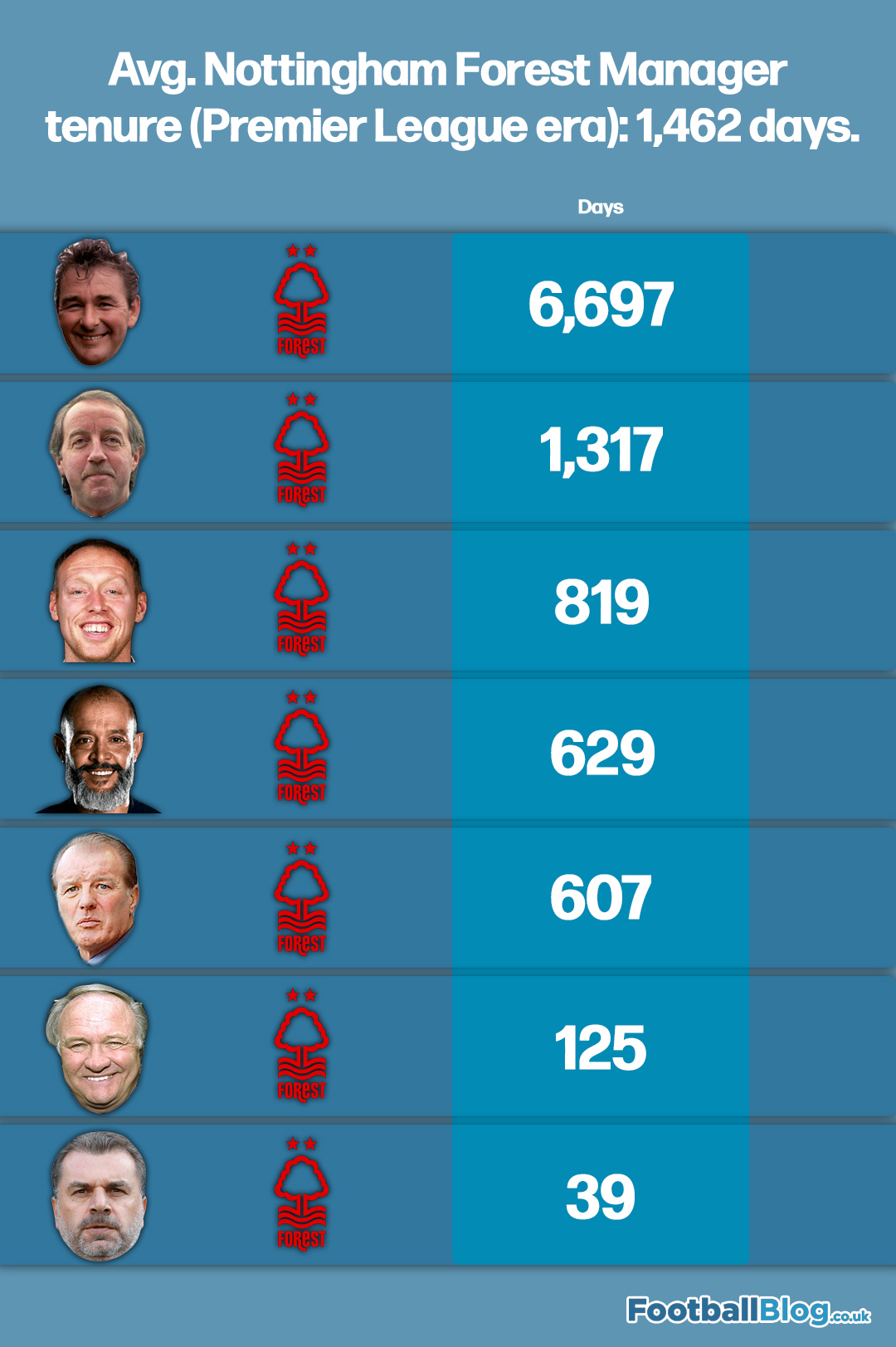
Average tenure for a Nottingham Forest manager during the Premier League era: 1,462 days
- Brian Clough: 6,697 days
- Frank Clark: 1,317 days
- Steve Cooper: 819 days
- Nuno Espirito Santo: 629 days
- Dave Bassett: 607 days
- Ron Atkinson: 125 days
- Ange Postecoglou: 39 days
What is the average length of a Premier League manager’s reign?
The mean average length of a Premier League manager’s reign is 891 days, which is just under two and a half years.
That figure is based on all managers who were not caretaker or interim appointments and whose continuous spell included at least one Premier League match. It also excludes spells that are currently ongoing.
The median length of time that a Premier League manager stays in a job is 607 days, while the mode is 629 days — which matches the length of spells served by Nuno Espirito Santo, Nigel Adkins and Ron Atkinson at Nottingham Forest, Reading and Coventry City respectively.
Only six clubs have competed in every season of the Premier League to date. They are Manchester United, Arsenal, Chelsea, Liverpool, Tottenham Hotspur and Everton. The mean spell of a Premier League manager at one of those ever-present clubs has been 1,078 days.
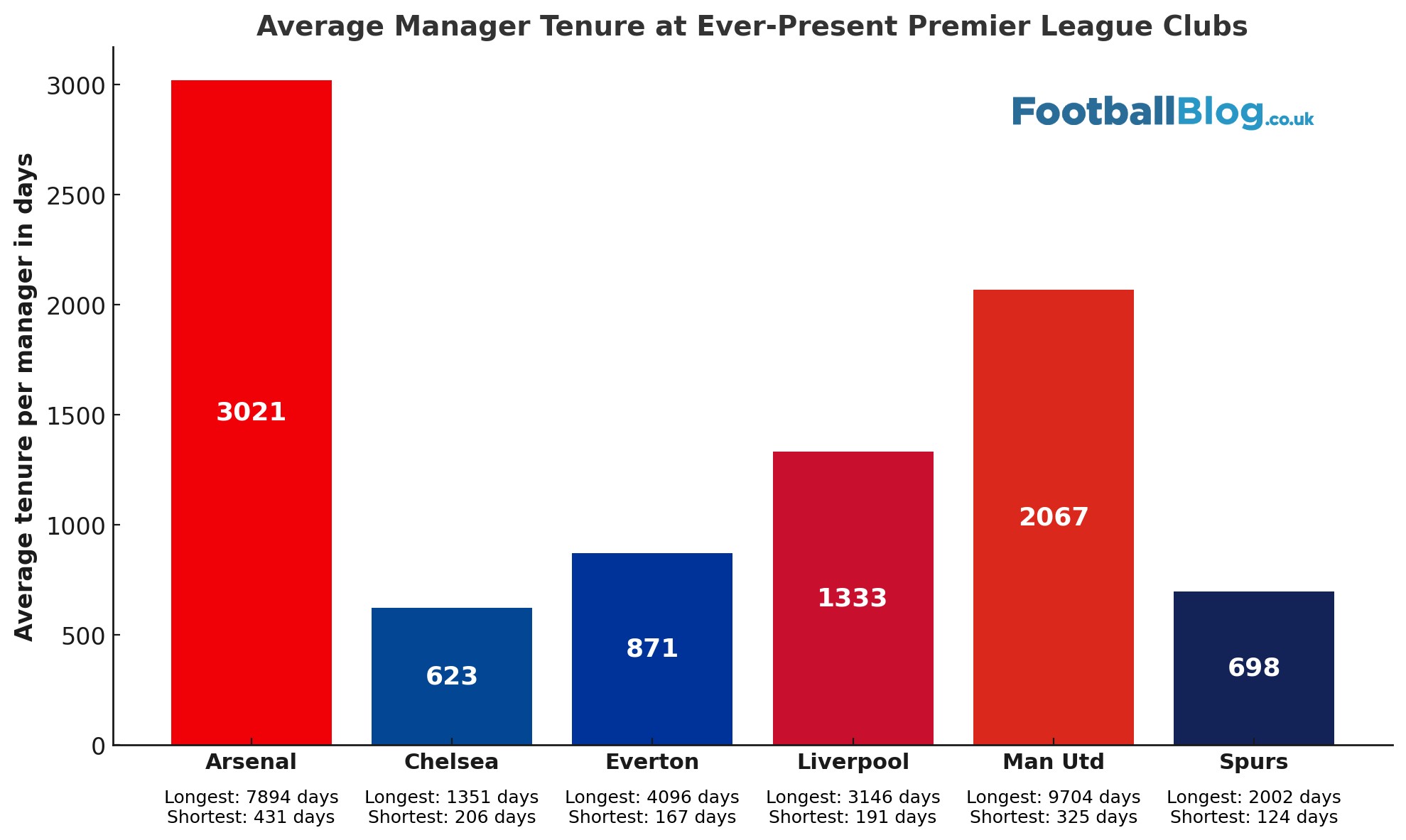
A graph showing the average tenure for a manager at the six ever-present Premier League clubs
Which Premier League club is the most patient with managers?
If we calculate patience purely on the average time a manager has stayed in his job at each club, then Arsenal are by far the most patient of the 20 clubs currently in the Premier League.
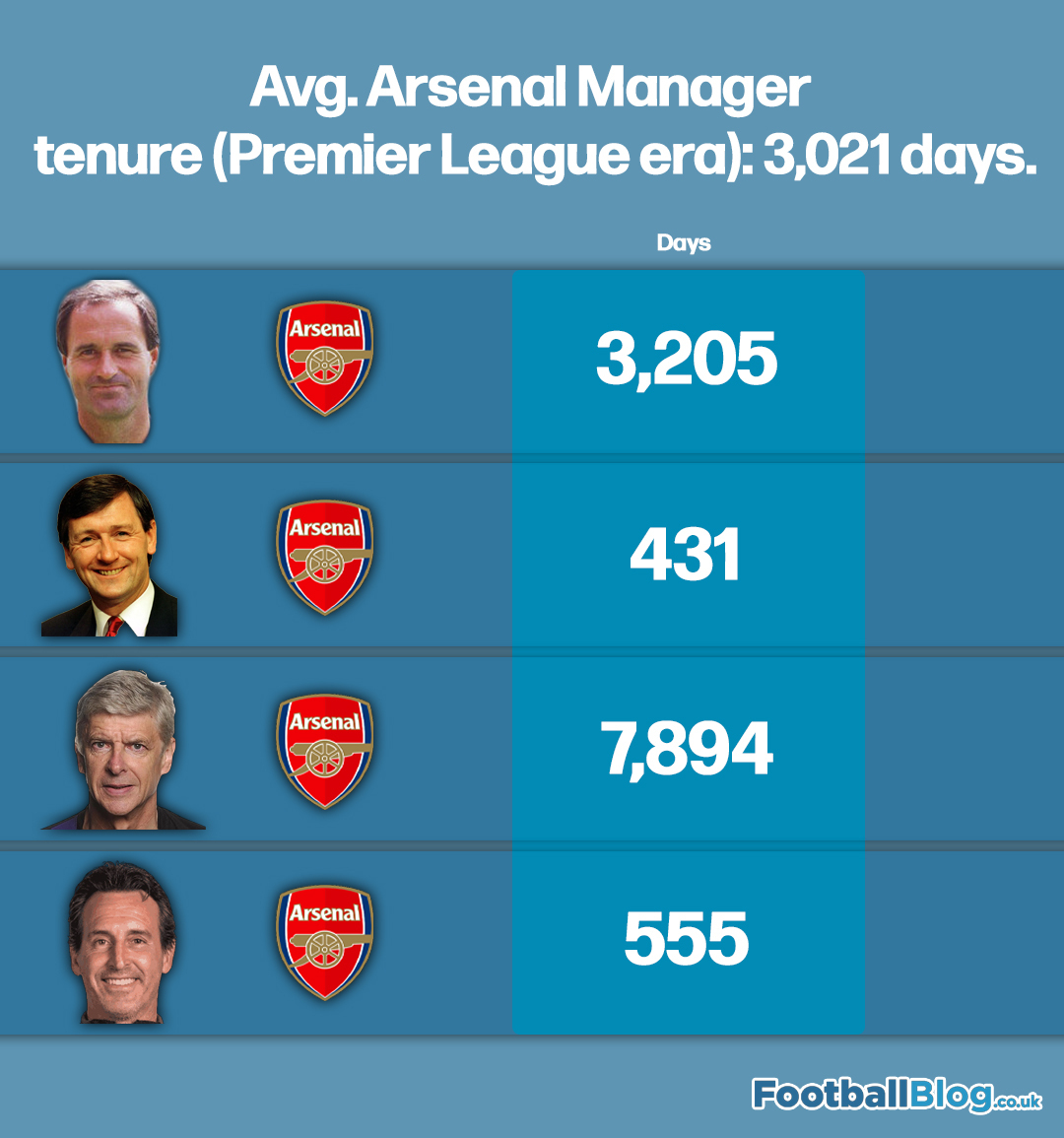
Not including current boss Mikel Arteta, the Gunners have had four permanent managers during the Premier League era: George Graham (3,205 days), Bruce Rioch (431 days), Arsene Wenger (7,894 days) and Unai Emery (555 days).
The average spell of Arsenal’s first four Premier League managers was 3,021 days, while Wenger remains second on the list of longest-serving Premier League managers — behind only Manchester United legend Sir Alex Ferguson.
There is technically one club from the Premier League era whose average is longer than Arsenal’s. That is Oldham Athletic, whose one and only manager during their sole Premier League season in 1992/93 was Joe Royle.
Royle spent 4,502 days in charge of Oldham from 1982 to 1994. Like Brian Clough at Forest, he still qualifies under the rules of this study even though the vast majority of his time in the role was spent outside the Premier League.
Average tenure for an Arsenal manager during the Premier League era: 3,021 days
- George Graham: 3,205 days
- Bruce Rioch: 431 days
- Arsene Wenger: 7,894 days
- Unai Emery: 555 days
Which Premier League club is the least patient with managers?
Perhaps unsurprisingly, Chelsea have been the least patient Premier League club with their managers.
Chelsea’s 18 permanent Premier League bosses — excluding current manager Enzo Maresca — have averaged 623 days in charge.
Claudio Ranieri lasted the longest of any Chelsea manager in the Premier League at 1,351 days, while Graham Potter’s 206-day spell sits at the other end of the scale.
Average tenure for a Chelsea manager during the Premier League era: 623 days
- Claudio Ranieri: 1,351 days
- Jose Mourinho: 1,205 days
- Glenn Hoddle: 1,071 days
- Gianluca Vialli: 943 days
- Jose Mourinho: 927 days
- Antonio Conte: 740 days
- Carlo Ancelotti: 720 days
- Ruud Gullit: 643 days
- Ian Porterfield: 615 days
- Thomas Tuchel: 588 days
- Frank Lampard: 571 days
- Maurizio Sarri: 337 days
- Mauricio Pochettino: 325 days
- Roberto Di Matteo: 262 days
- Andre Villas-Boas: 256 days
- Avram Grant: 238 days
- Luiz Felipe Scolari: 223 days
- Graham Potter: 206 days
As revealed by FootballBlog.co.uk recently, Chelsea have spent £156.6 million on compensation after sacking managers during the Premier League era.
That total is roughly the same as Manchester United (£52.4m), Liverpool (£50.8m), Arsenal (£29.3m) and Manchester City (£24.25m) combined.
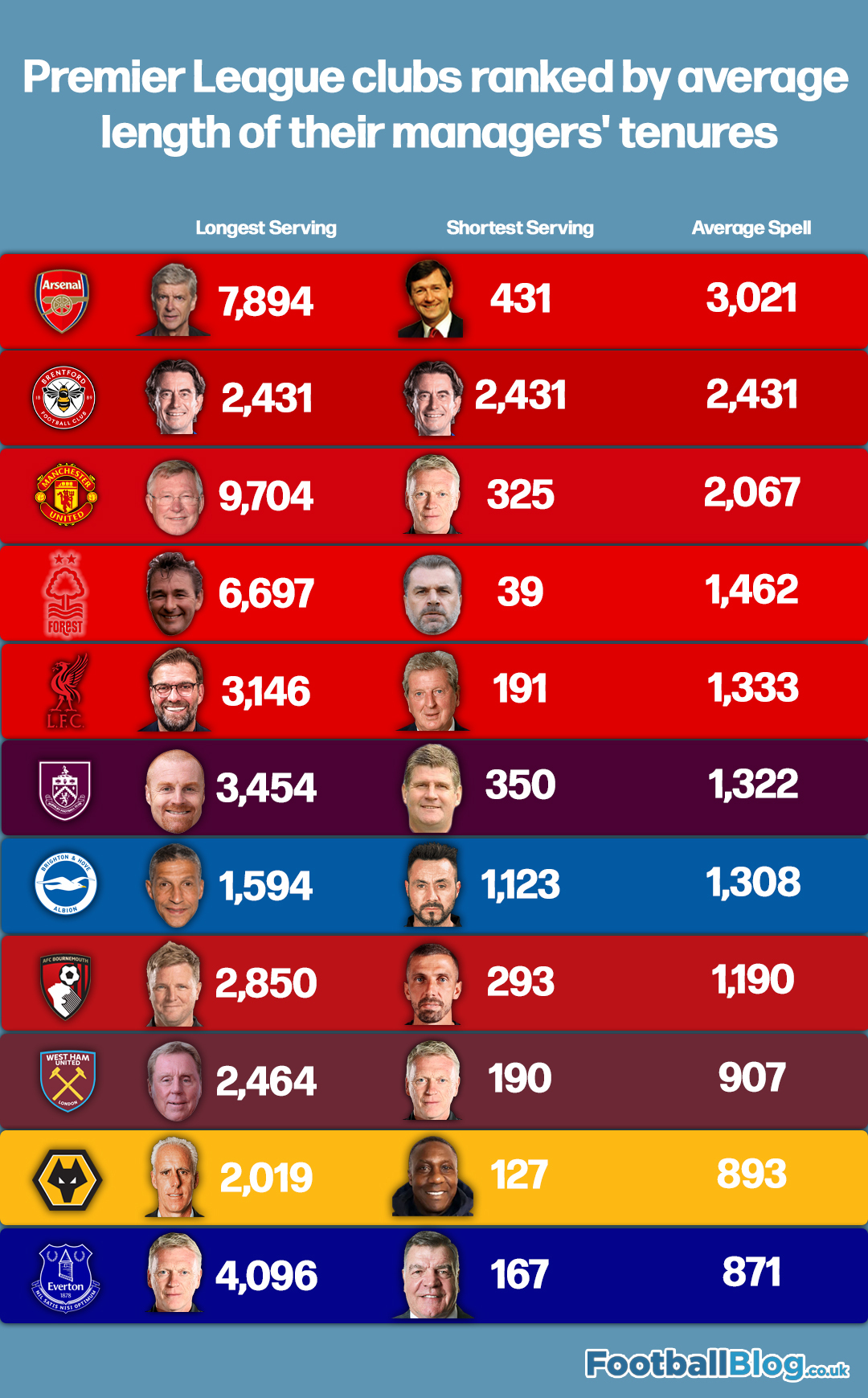
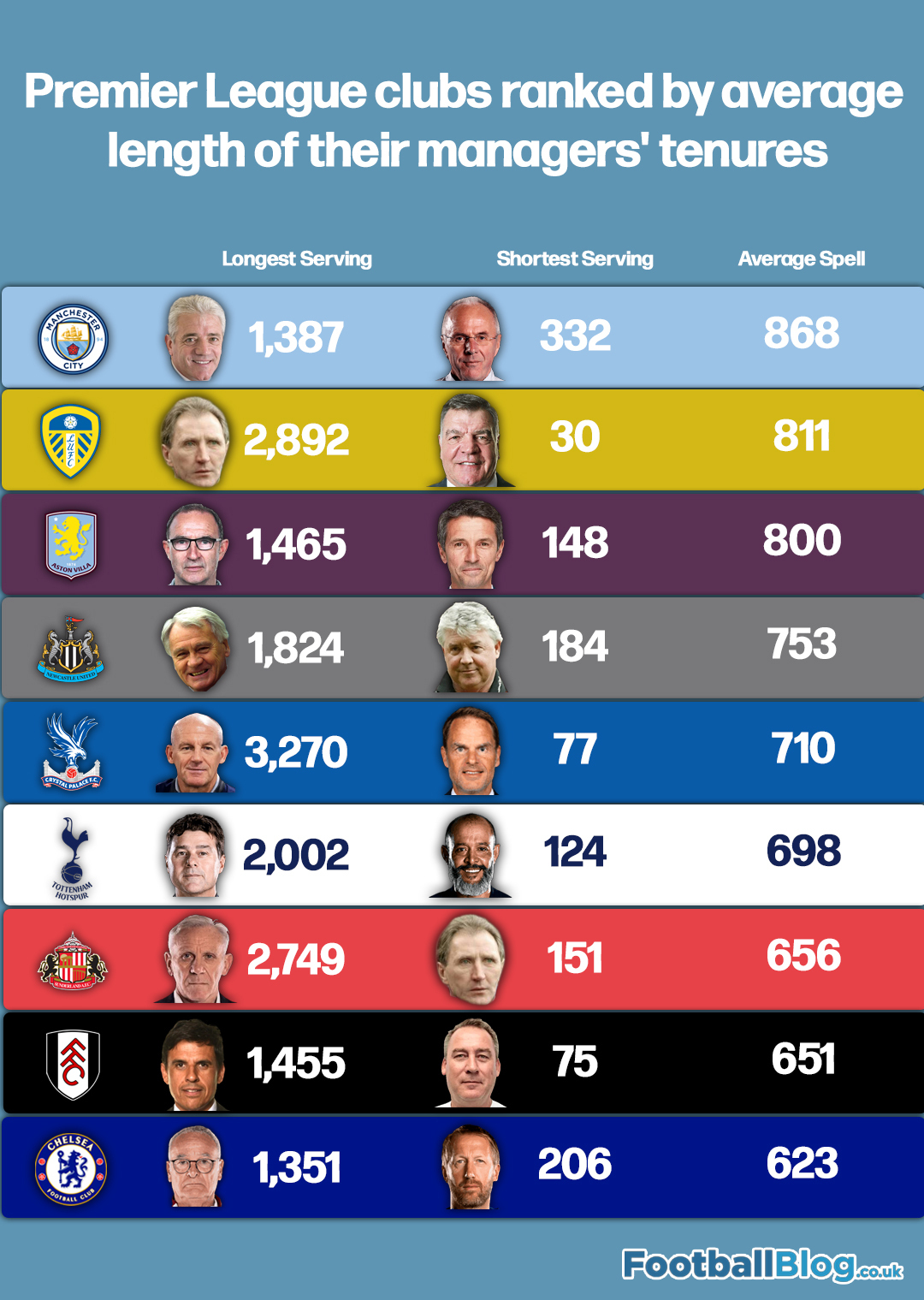
All 20 Premier League clubs ranked by average length of their managers’ tenures
| Club | Longest Serving | Shortest Serving | Avg Spell |
| Arsenal | Wenger (7,894 days) | Rioch (431 days) | 3,021 days |
| Brentford | Frank (2,431 days) | Frank (2,431 days) | 2,431 days |
| Man United | Ferguson (9,704 days) | Moyes (325 days) | 2,067 days |
| Nott’m Forest | Clough (6,697 days) | Postecoglou (39 days) | 1,462 days |
| Liverpool | Klopp (3,146 days) | Hodgson (191 days) | 1,333 days |
| Burnley | Dyche (3,454 days) | Laws (350 days) | 1,322 days |
| Brighton | Hughton (1,594 days) | De Zerbi (1,123 days) | 1,308 days |
| Bournemouth | Howe (2,850 days) | O’Neil (293 days) | 1,190 days |
| West Ham | Redknapp (2,464 days) | Moyes (190 days) | 907 days |
| Wolves | McCarthy (2,019 days) | Connor (127 days) | 893 days |
| Everton | Moyes (4,096 days) | Allardyce (167 days) | 871 days |
| Man City | Keegan (1,387 days) | Eriksson (332 days) | 868 days |
| Leeds | Wilkinson (2,892 days) | Allardyce (30 days) | 811 days |
| Aston Villa | O’Neill (1,465 days) | Garde (148 days) | 800 days |
| Newcastle | Robson (1,824 days) | Kinnear (184 days) | 753 days |
| Crystal Palace | Coppell (3,270 days) | De Boer (77 days) | 710 days |
| Tottenham | Pochettino (2,002 days) | Espirito Santo (124 days) | 698 days |
| Sunderland | Reid (2,749 days) | Wilkinson (151 days) | 656 days |
| Fulham | Coleman (1,455 days) | Meulensteen (75 days) | 651 days |
| Chelsea | Ranieri (1,351 days) | Potter (206 days) | 623 days |
Most patient Premier League clubs: 1st-10th
11th-20th
Does Ange Postecoglou hold the record for shortest managerial tenure in Premier League history?
No. Ange Postecoglou’s sacking after just 39 days places him second on the list of shortest-serving managers in Premier League history.
Not including managers who were specifically appointed as caretakers or interim bosses, the only Premier League manager to have a shorter tenure than Postecoglou was Sam Allardyce, who spent just 30 days in charge of Leeds United in 2023.
Allardyce was brought in on an initial short-term contract on May 3, with the aim of keeping Leeds in the Premier League. But he failed to win any of his four games in charge, Leeds were relegated, and it was decided on June 2 that he would not continue in the role.
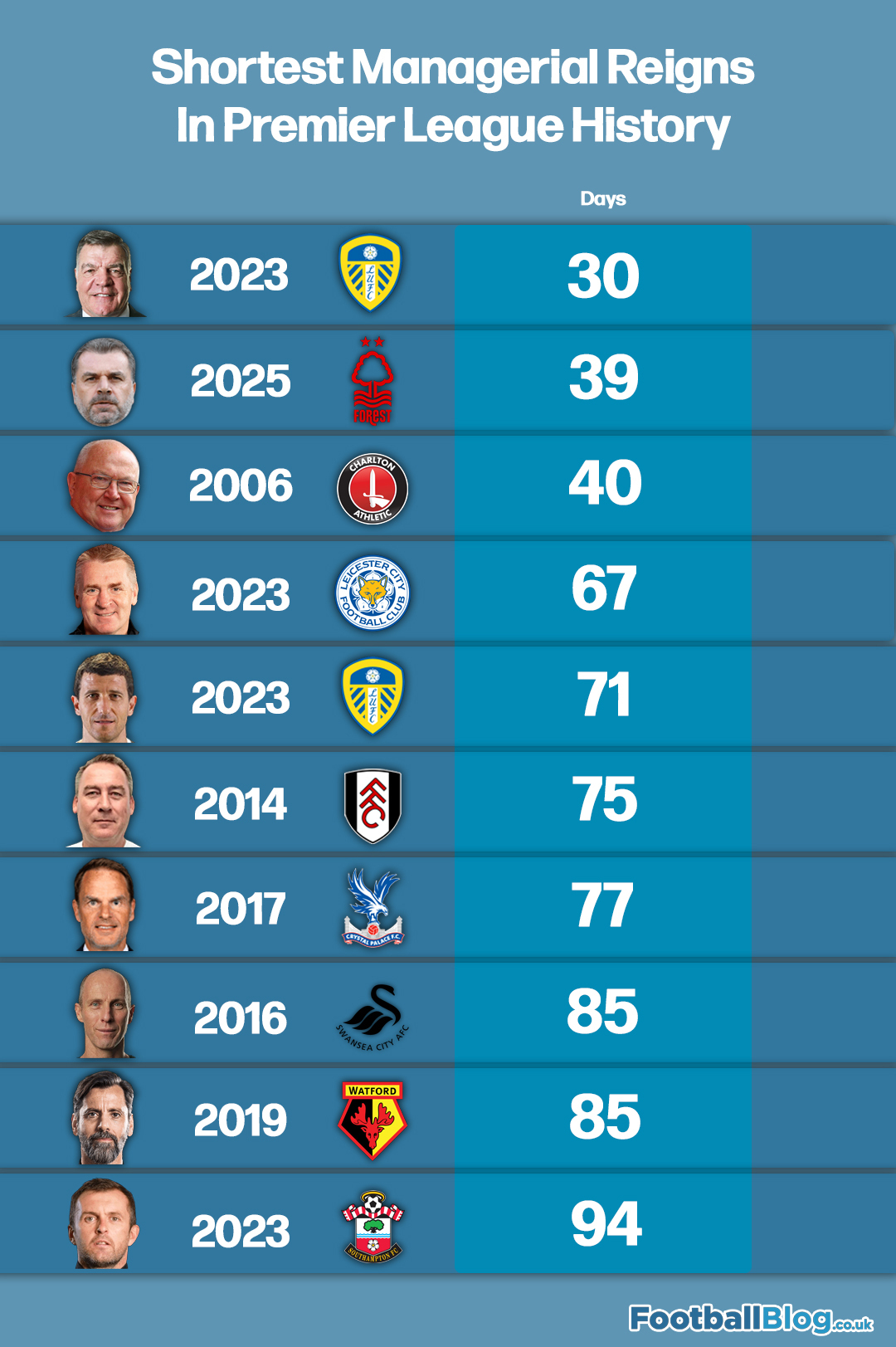
Shortest managerial reigns in Premier League history
1. Sam Allardyce — 30 days as Leeds United manager (2023)
2. Ange Postecoglou — 39 days as Nottingham Forest manager (2025)
3. Les Reed — 40 days as Charlton Athletic manager (2006)
4. Dean Smith — 67 days as Leicester City manager (2023)
5. Javi Gracia — 71 days as Leeds United manager (2023)
6. Rene Meulensteen — 75 days as Fulham manager (2013–2014)
7. Frank de Boer — 77 days as Crystal Palace manager (2017)
=8. Bob Bradley — 85 days as Swansea City manager (2016)
=8. Quique Sanchez Flores — 85 days as Watford manager (2019)
10. Nathan Jones — 94 days as Southampton manager (2022–2023)
Methodology
This study analysed every permanent manager to have taken charge of a Premier League club since the competition began in 1992.
Managers who oversaw at least one Premier League match were included, but caretaker and interim managers were excluded, as were managers currently in their jobs, to prevent ongoing tenures from skewing the averages.
For consistency, each manager’s full continuous spell in charge was counted — including days before or after any relegation or promotion.
For managers who were in post before the Premier League began and continued into the Premier League era, we have included the full length of their tenure, including the period before 1992.
All figures were calculated using available start and end dates, measured in calendar days.
If you wish to use any information or graphics from this article, please include a credit and link back to FootballBlog.co.uk

 Saliba’s Back Injury: No Surgery, No Return Date as Arsenal Plan Around Absence
- Real Madrid Close to Personal Terms With Rodri as City Talks Loom
- Emery Reunion Drives Villa’s Move for £65m-Rated Jackson
- PSG’s £120m-Plus Barcola Demand Puts FSG’s Ambition to the Test
- Savinho to Spurs: Why the £60m Man City Deal Looks Done
- Inter Eye Cristian Romero But €50m Fee and Wages Create Major Hurdles
- Trafford the Only Keeper Target as Leeds Stall on Charles and Chase Brandt
- Argentina Face FIFA Investigation After World Cup Final Confrontations
- Guimarães Bid Incoming and Williams Opens Door in Arsenal’s £167m Push
- Ferran Torres Transfer: Liverpool and PSG Compete for Barcelona Forward